By Dr Anjali Mahto, Consultant Dermatologist and Founder of Self London
Key Takeaways
- HALO laser is best suited to mild-to-moderate skin ageing, sun damage, uneven pigmentation, enlarged pores, fine lines and mild acne scarring.
- It cannot address every concern. Deeper acne scars, melasma and significant structural facial ageing may require alternative treatments or a tailored approach.
- Skin type, pigmentation history, medical background and previous treatments all influence suitability and the risk of complications.
- Expect around five days of visible recovery, with textural improvements continuing to develop over the following weeks and months.
- HALO can be combined with other laser technologies where appropriate, but every treatment should have a clear purpose based on individual needs.
- Results can be long-lasting, but HALO does not stop ageing or prevent future sun damage. Further treatment should be based on individual needs rather than a fixed schedule.
- A consultation with an experienced clinician helps determine whether HALO, another treatment or a combination will deliver the most appropriate results.
HALO is one of the resurfacing lasers we use regularly at Self London, and in the right patient it can give a beautiful result. We tend to like it most for mild-to-moderate skin ageing or photodamage, particularly where there is a mixture of uneven pigmentation, enlarged pores, early fine lines and relatively mild textural change. It can also work very well for mild acne scarring and for patients who want their skin to look clearer, smoother and generally more polished.
It is not the laser we would choose for everybody. Moderate-to-severe acne scarring usually needs a different approach; active melasma requires much more caution; significant structural facial ageing cannot be corrected simply by resurfacing the skin; and HALO is unlikely to suit somebody who cannot accommodate several days of visible recovery. We are also more selective in darker Fitzpatrick skin types. HALO can work extremely well in melanated skin (I am Fitzpatrick V and have had an excellent result from it myself) but the risk of post-inflammatory hyperpigmentation needs to be considered, and we have other resurfacing technologies available when we prefer a different treatment profile.
For us, the relevant question is rarely whether a machine can be used. It is whether, given the other options available, it is the treatment we would actually choose for that particular skin type and concern.
Where HALO sits within laser resurfacing
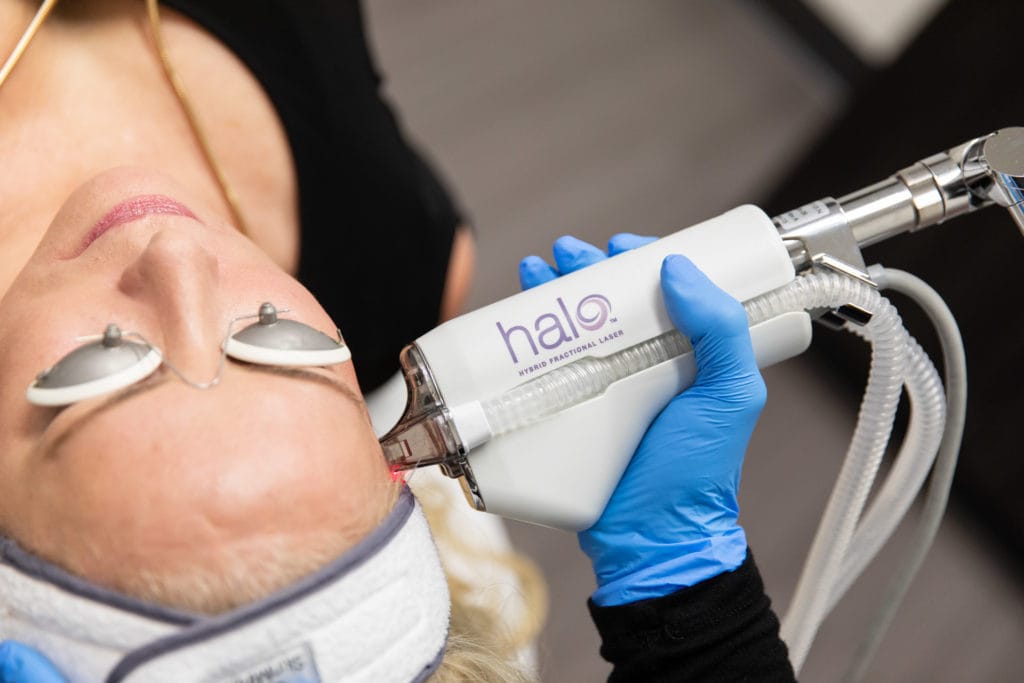
HALO is a hybrid fractional laser. It combines a 1470 nm non-ablative wavelength with a 2940 nm ablative Er:YAG wavelength, allowing us to produce different tissue effects at different depths during the same treatment. The more superficial component contributes to epidermal renewal and pigmentary change, while the deeper non-ablative component creates controlled thermal injury within the dermis and stimulates a wound-healing response.
Because treatment is fractional, microscopic columns of skin are treated with areas of untreated tissue left between them. This allows recovery to occur more quickly than after traditional full-field resurfacing while still producing meaningful tissue remodelling.
The technology has a published clinical evidence base for photoageing, pigmentation, fine lines and texture, and hybrid fractional resurfacing has also been studied in scarring.[1–3] As with much of procedural dermatology, the literature is smaller and less standardised than the evidence base for medicines, which makes patient selection, treatment parameters and operator experience particularly important.
What I find useful about HALO is the position it occupies between very light treatments and more aggressive resurfacing. There is enough treatment to produce a visible improvement in skin quality, but for the right patient the recovery is generally more manageable than a deeper ablative procedure.
The patient in whom HALO tends to work particularly well
A typical HALO patient in our clinic has accumulated a mixture of relatively early changes rather than one severe structural problem. There may be mottled sun-related pigmentation, enlarged pores, fine lines and a slightly rougher or less even skin surface. Patients often describe their skin as looking duller, more weathered or simply not as good as it used to.
Some will ask for a “glow-up”, which is not a dermatological diagnosis but is quite a good description of the result HALO can produce in the right skin. When the underlying problem is mild-to-moderate photodamage and textural change, the combination of epidermal renewal and deeper remodelling can give a clearer, smoother and more refined appearance without needing to move straight to an aggressive resurfacing treatment.
Mild acne scarring can also fall into this category. A patient with enlarged pores, relatively shallow atrophic scars and broader textural irregularity may do very well. Once the scars become deeper, more tethered or sharply defined, however, the treatment problem changes because we are no longer dealing simply with surface texture.
Chronological age is not particularly helpful when choosing a laser. We see younger patients with considerable photodamage and older patients whose skin has been exceptionally well protected. The more useful questions are what is actually present in the skin, how deeply it sits, how that skin behaves after inflammation, how much recovery the patient can accept and what degree of change would genuinely make the treatment worthwhile.
HALO has a treatment ceiling
Every laser has a point beyond which asking it to do more becomes inefficient. HALO is no different. Increasing the intensity or repeating treatment does not turn it into the correct answer for a problem that sits at a different depth or requires a different type of intervention.
Acne scarring demonstrates this particularly well. There is a fundamental difference between improving surface texture and changing scar architecture. Rolling scars may be tethered beneath the skin by fibrous attachments, boxcar scars have defined edges and varying depth, and ice-pick scars can extend much more deeply into the dermis. A patient may have all three, which is why scar morphology has long been used to guide treatment choice.[4]
If someone has mild superficial scarring, HALO can be a very attractive option. If they have moderate-to-severe disease, we may need to release tethered scars, treat focal scars individually, use deeper fractional Er:YAG resurfacing or employ different techniques in different areas. Simply increasing the treatment over the whole face is not necessarily a better way of treating a small number of deeper scars.
This is why HALO is not our default treatment for significant acne scarring. It can form part of a wider plan, particularly where we also want to improve pores and surrounding texture, but the treatment has to follow the scar morphology rather than the other way around.
My own experience of HALO in Fitzpatrick V skin
I am Fitzpatrick skin type V and have had HALO myself, with an excellent improvement in pigmentation. I chose it because I wanted to treat pigment and improve overall skin quality while having less pinpoint bleeding and downtime than I would expect from a more ablative approach. My own skin was particularly glowy between about two and four weeks afterwards, and I was very pleased with the result.
I mention this because being cautious about HALO in melanated skin is quite different from saying it should not be used. Fractional resurfacing can be performed very successfully in darker skin types, but melanated skin has a greater propensity to develop post-inflammatory hyperpigmentation after inflammatory procedures and we occasionally see this following laser treatment. That risk should influence how the treatment is selected and delivered.
My own result does not mean that I would automatically recommend HALO to every Fitzpatrick V patient. The type of pigmentation, previous pigmentary response, treatment intensity and the alternatives available require a considered plan. If we are concerned about the likelihood of post-inflammatory hyperpigmentation in a particular patient, I may reach instead for ProFractional or UltraClear.
This is one of the advantages of having several resurfacing technologies available. It gives us the option to choose a different platform when the balance of benefit, inflammation and pigmentary risk makes more sense for the individual patient, rather than trying to make the same device fit everybody. Fractional lasers can be used successfully in darker phototypes, but the published literature also supports careful device and parameter selection in this group.[5]
Brown is a colour, not a diagnosis
Pigmentation is one of the commonest reasons patients seek laser treatment, but “brown pigment” can represent several very different biological processes. Solar lentigines or freckles, post-inflammatory hyperpigmentation and melasma may look superficially similar to the patient but behave very differently when treated.
Melasma is the most obvious example. It is a chronic, relapsing pigmentary disorder influenced by ultraviolet and visible light, hormonal factors, melanocyte activity and inflammatory and vascular signalling. Laser can have a role in carefully selected cases, particularly when conventional approaches have not been sufficient, but published evidence supports a much more nuanced approach than simply treating visible pigment with resurfacing.[6]
HALO is therefore not a treatment we routinely reach for simply because somebody has melasma. We are more interested initially in how stable the condition is, what has previously been tried, whether the patient is adequately protected from light exposure and whether medical treatment has been optimised.
The same reasoning applies to pigmentation more generally. Identifying that something is brown is easy; understanding why it is brown is what determines whether a laser is likely to help.
Mild-to-moderate skin ageing is different from structural ageing
The language around aesthetic treatments often collapses everything into “anti-ageing”, but the ageing face changes at several levels. There are changes within the epidermis and dermis, but also within fat, retaining ligaments and bone. No resurfacing laser can reasonably be expected to correct all of them.
HALO is at its best where the concern is genuinely the quality of the skin: photodamage, early lines, pores, uneven pigmentation and texture. It cannot reposition significantly descended tissue, restore skeletal support or correct substantial volume loss.
This is important to bear in mind when somebody says they want to “look younger”. If improved pigment and texture are likely to give them what they want, resurfacing can be very worthwhile. If the main concern is jowling or more advanced structural change, better skin may still be valuable but it is unlikely to be the whole answer. A treatment can work perfectly well and still disappoint if it was asked to solve the wrong problem.
Why several laser platforms are useful
Self London was built deliberately around more than one laser technology. HALO sits alongside ProFractional Er:YAG, UltraClear 2910 nm, full-field Er:YAG resurfacing, BBL and vascular technologies because the conditions we treat differ in depth, biology and optical target.
There is nothing inherently impressive about owning lots of machines. The value comes from having meaningful alternatives and understanding when those alternatives change the treatment plan. A clinic with one excellent laser can become very skilled with it, but the range of available solutions will inevitably be narrower.
In practice, one patient may be very well suited to HALO while another would be better treated with UltraClear. A scar patient may need localised ProFractional rather than more aggressive HALO treatment over an entire area, while somebody whose dominant problem is vascular redness may not need resurfacing as their starting point at all.
Having several tools should not result in patients having more procedures. Ideally, it gives us greater precision because each treatment is being asked to do the job it is best suited to.
When we combine HALO with other technologies
Some of the treatment combinations we use at Self London are a good illustration of how this works in practice. One that I particularly like in appropriately selected patients is BBL with HALO, where colour and texture both need attention. BBL can address appropriate pigmentary and vascular components of photodamage while HALO deals with broader resurfacing, pores and texture.
In another patient, BBL and HALO may be combined with localised UltraClear around the eyes where the periocular skin requires a different treatment approach. Where somebody has broader mild scarring but several deeper areas, we may use HALO across the larger treatment area with localised ProFractional where more intensive resurfacing is required.
These are not fixed packages. The fact that a combination works beautifully in one patient does not mean that everybody should receive it. Each element needs a reason for being there; otherwise combination treatment becomes little more than using extra machines for the sake of it.
This is where a broader laser practice becomes useful. Rather than increasing the intensity of one device in an attempt to make it solve every component of the problem, different technologies can be used selectively where their particular tissue effects are useful.
The person behind the laser
Patients understandably spend a lot of time researching machines, but considerably less attention is sometimes paid to the person using them. We would not choose a surgeon simply because they knew how to use a scalpel; the instrument matters, but the greater expertise lies in understanding the anatomy, recognising the problem and deciding what needs to be done.
Laser is similar. HALO cannot decide whether the pigmentation in front of it is solar damage or melasma, whether an acne scar is tethered, whether a darker skin type would be better served by another fractional platform or whether the problem needs resurfacing at all. Nor does “HALO treatment” describe one fixed procedure, because treatment depth, density and the balance between ablative and non-ablative injury can all be adjusted.
Two people can therefore both say that they have had HALO and have received quite different treatments. The fact that two clinics own the same machine tells you which technology was available; it does not tell you whether the diagnosis was correct, whether the settings were appropriate or whether that laser was the best choice for that patient.
How much downtime does HALO have?
HALO tends to have less downtime than more aggressive ablative resurfacing, but it is not a no-downtime treatment. Patients should expect some combination of redness, swelling, bronzing and a dry or sandpaper-like texture before the treated skin settles.
In our practice, we generally advise patients to plan around approximately five days during which the skin will look visibly treated. Some recover faster, while stronger treatment or individual healing differences can extend this.
Downtime should be part of deciding whether somebody is a good candidate rather than a detail introduced after they have decided to proceed. If somebody has an important public event in two days and cannot look treated, HALO may be an excellent treatment for their skin and still be completely wrong for their diary.
The early HALO glow and the later result
The early improvement after HALO can be very attractive. Once the initial recovery has settled, superficial pigment looks clearer, the surface is smoother and light reflects more evenly from the skin. In my own case, the glow was particularly noticeable between two and four weeks.
I would not use that point to judge the entire treatment result. The surface has recovered long before dermal wound healing and remodelling have finished. Fibroblast activity and collagen synthesis begin relatively early following fractional injury, while the production, organisation and maturation of the extracellular matrix continue over subsequent weeks and months. Histological studies of fractional Er:YAG resurfacing have demonstrated new collagen production and changes within the dermal matrix continuing well after the face has stopped looking as though it has recently been treated.[7]
We generally regard eight to twelve weeks as a more meaningful point at which to assess the developing textural result, while recognising that biological change can continue beyond that. Patients can therefore enjoy the early glow without assuming that what they see at two weeks is the finished product.
Where HALO fits into skin longevity
Skin longevity has become a fashionable phrase and, like most fashionable phrases in aesthetics, it is in danger of being asked to mean too much. There is nevertheless a sensible biological argument for considering resurfacing as part of maintaining skin quality over time because fractional laser injury can stimulate fibroblast activity, collagen production and remodelling of photodamaged extracellular matrix.
There is also interesting human research looking at longer-term biological changes after fractional resurfacing in older, heavily photodamaged skin. We have discussed that work in detail in our separate guide to the long-term benefits of laser resurfacing, where it belongs. For us, skin longevity means maintaining good-quality skin over time and treating damage when there is something worth treating. Laser can form part of that approach, alongside photoprotection, sensible skincare and management of actual skin disease.
Do HALO results need maintenance?
Laser resurfacing can produce a long-lasting improvement, but it does not stop ageing. New ultraviolet damage can accumulate, pigmentation can recur or develop elsewhere and collagen continues to change with time, so some patients will choose further treatment in the future.
We do not regard HALO as an automatic annual appointment. If somebody still has excellent skin and is happy with their result, there is no logical reason to create another wound simply because six or twelve months have elapsed. If the skin later develops enough new photodamage or textural change to make another procedure worthwhile, we reassess it; HALO may again be the most sensible treatment, or another technology may now be more appropriate.
What happens at a HALO consultation at Self London?
Self London is a consultant dermatologist-led skin and laser clinic on Harley Street in London. Our laser work includes acne and acne scarring, pigmentation, redness, photodamage and skin ageing, and treatment planning begins with assessment rather than with choosing a machine.
We look at what the patient wants to improve, the clinical diagnosis, Fitzpatrick skin type, pigmentary history, previous treatments, medical history, likely recovery and the degree of change they expect. Standardised photography and VISIA imaging are used where appropriate because an objective baseline is useful, particularly when we are treating pigment, redness or texture.
Imaging does not replace clinical judgement. A VISIA image can demonstrate areas of brown pigment, but it cannot decide whether that pigment represents solar damage, melasma or post-inflammatory change. The diagnosis still determines what we do next.
We do not perform HALO or other significant resurfacing treatment on the day of the initial consultation. Patients should have the opportunity to understand why a particular treatment has been recommended, what the alternatives are, what recovery will look like and what the treatment can realistically achieve before making a decision.
Some laser treatments at Self London are performed by consultant dermatologists and others by experienced laser practitioners working within the clinic’s treatment plans and protocols. Assessment, agreed parameters, documentation, aftercare and medical escalation sit within the same clinical framework, so the expertise belongs to the clinic rather than depending on one individual physically holding every handpiece.
Patients do not need to know which laser to book before they come to us. Deciding whether the answer is HALO, another technology, a combination or no laser at all is part of the consultation.
So who is HALO actually for?
HALO works particularly well in the patient with mild-to-moderate photodamage or skin ageing, enlarged pores, uneven superficial pigmentation, early lines, mild scarring and broader textural change who wants a noticeable improvement in skin quality and can accommodate several days of visible recovery.
Outside that group, the treatment plan becomes more individual. Moderate-to-severe acne scarring may need treatment at greater depth or correction of scar tethering; darker skin may make us prefer another fractional technology where pigmentary risk concerns us; melasma requires a different way of thinking about pigmentation; and structural facial ageing cannot be corrected by resurfacing the skin alone.
HALO remains one of the lasers we value highly at Self London because we can use it where it performs particularly well and choose something different when the skin, anatomy or treatment objective points us in another direction.
References
- Waibel JS, Pozner J, Robb C, Tanzi E. Hybrid Fractional Laser: A Multi-Center Trial on the Safety and Efficacy for Photorejuvenation. Journal of Drugs in Dermatology. 2018;17(11):1164–1168. PMID: 30481954.
- Fusano M, Bencini PL, Galimberti MG. Hybrid fractional laser treatment for photodamaged facial skin rejuvenation 6 years following fractional CO₂: comparison of clinical outcome and patients’ satisfaction. Lasers in Surgery and Medicine. 2022;54(8):1045–1050. doi:10.1002/lsm.23583.
- Estupiñan B, Pinsky S, Ly K, Goldberg DJ. Review of Hybrid Fractional Ablative and Non-Ablative Resurfacing Lasers in Aesthetic Dermatology. Dermatological Reviews. 2026;7(2):e70073. doi:10.1002/der2.70073.
- Jacob CI, Dover JS, Kaminer MS. Acne scarring: a classification system and review of treatment options. Journal of the American Academy of Dermatology. 2001;45(1):109–117. doi:10.1067/mjd.2001.113451.
- Aggarwal I, Rossi M, Puyana C, Tsoukas M. Review of Fractional Nonablative Lasers for the Treatment of Dermatologic Conditions in Darker Skin Phototypes. Dermatologic Surgery. 2024;50(5):459–466. doi:10.1097/DSS.0000000000004111.
- Zhao S, Wang M, Lai X, Yan Y. Efficacy and Safety of Ablative Fractional Laser in Melasma: A Meta-analysis and Systematic Review. Lasers in Medical Science. 2024;39(1):71. doi:10.1007/s10103-024-03972-w.
- El-Domyati M, Abd-El-Raheem T, Medhat W, Abdel-Wahab H, Al Anwer M. Multiple fractional erbium:YAG laser sessions for upper facial rejuvenation: clinical and histological implications and expectations. Journal of Cosmetic Dermatology. 2014;13(1):30–37. doi:10.1111/jocd.12079.