 Written by Dr Anjali Mahto
By Dr Anjali Mahto, Consultant Dermatologist with a clinical focus on laser treatments and acne scarring, and founder of Self London.
Dr Anjali Mahto explains her combined erbium:YAG laser treatment for an under-recognised form of acne scarring, reported in the British Journal of Dermatology.
Key takeaways
- Papular acne scars are a less recognised type of acne scarring, appearing as small, raised, skin-coloured or pale bumps.
- Unlike ice-pick, boxcar and rolling scars, papular scars create a raised contour rather than a depression in the skin.
- In this case, I combined targeted erbium laser ablation with fractional erbium laser treatment using ProFractional.
- The skin surface healed within seven days, with redness and swelling settling within two weeks.
- The report described reduced scar prominence and smoother texture, with no adverse effects reported during two months of follow-up.
- This was a single case report, and further research is needed to establish how reliably the approach works in other patients.
Most discussion of acne scarring focuses on depressions in the skin: ice-pick, boxcar and rolling scars. Papular acne scars are a less recognised pattern, forming small, raised, skin-coloured or pale bumps. They have been described on the chin, nose and trunk, and can occur alongside other types of acne scarring.
There is relatively little published research on their treatment. For a dermatologist, the challenge is to reduce the raised scar without removing too much tissue or damaging the surrounding skin. A patient I treated at Self London illustrates how I approached this using two forms of erbium laser treatment. We subsequently reported the case in a conference supplement of the British Journal of Dermatology.
What are papular acne scars?
Papular scars can give the skin a cobblestone appearance. Examination of tissue samples has shown fibrosis, or scar tissue, in the upper dermis, beneath the skin’s outer layer. This produces a different treatment problem from a depressed scar: there is a raised contour to reduce, as well as scarred tissue within the skin.
They are under-recognised and have been overlooked in acne-scar classification. In a study of 416 patients with acne scarring, approximately 11% had papular scars, compared with almost 99% who had depressed scars. Some patients had both types. These figures come from a selected clinical population and should not be taken as a measure of how common they are in the wider population.
A diagnosis requires clinical assessment. Persistent raised lesions on the chin or nose should not automatically be attributed to previous acne, even in someone with a history of breakouts. Papular scars also need to be distinguished from other raised scars, including keloids, before treatment is considered.
There is very little published data in the literature on how best to manage this atypical scar type. A 2017 paper described improvement in two patients with papular chin scars treated using an erbium pinhole method, in which small channels were created within the scars. This paper informed part of my approach. Other treatments, including CO₂ laser, have also been reported, but the available evidence does not establish a single best treatment for papular scars.
Treating papular chin scars with erbium laser
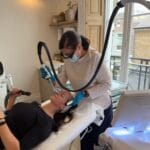
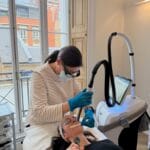
The patient was a 27-year-old woman with papular scars on her chin and no active acne. I assessed her and developed a treatment plan with two stages in the same procedure: first reducing the raised bumps individually, then using fractional erbium laser across the scarred area. I selected the settings and performed both stages after consultation and assessment.
I chose erbium because I wanted to cut away the raised tissue while keeping heat damage to a minimum. The bumps were different heights, so I reduced them individually, checking their level against the surrounding skin as I worked. Taking off too much could have left a depression or “indent”.
Erbium’s wavelength is strongly absorbed by water in the skin. This allows it to remove thin layers of tissue with relatively little residual thermal injury, although the effect depends on the settings and how the laser is used. For this patient, I wanted that precise removal without additional coagulation or heat.
During this first stage, I used targeted ablation, removing tissue in thin increments. This allowed me to reassess each scar as I worked. The amount of treatment was determined by its height and contour, rather than giving every bump the same number of passes.
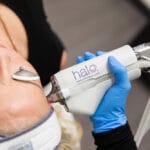
Once the bumps had been reduced, I began the second stage using ProFractional, a fractional erbium laser. This creates narrow channels within the skin, leaving untreated tissue between them. It allows treatment within the dermis without removing the whole surface to the same depth.
The intention of this second stage was to improve texture through the skin’s repair response. As the small wounds heal, connective tissue is produced and reorganised. The previously published erbium pinhole report had informed this part of my approach, but I chose the combination, depths and density for this patient based on understanding and experience of laser physics and the skin. The idea was to encourage remodelling in the area without adding more thermal injury.
Developing the treatment plan
There was no established protocol for the combination I chose. I drew on the published reports, my understanding of laser physics, my experience with erbium resurfacing and my assessment of this patient’s skin. That included deciding how much tissue to remove, the depth and density of the fractional treatment, and whether additional coagulation would serve any useful purpose.
For fractional treatment, depth determines how far the channels extend into the skin, while density determines the proportion treated in each pass. These settings need to be considered together, alongside the number of passes and any preceding ablation. The skin has to heal from the combined effects of the procedure.
Those decisions require familiarity with the device and experience of how skin responds during treatment. A setting on a screen cannot tell you whether a scar has been reduced sufficiently or whether further treatment would cause unnecessary injury. I had to make those judgements as I worked, while accounting for the recovery that would follow.
The literature informed the treatment, but applying it to this patient required clinical judgement. I used knowledge and experience to develop a plan for her particular scars. Our subsequent report adds a documented example of the combined approach to the limited literature on papular acne scarring.
Recovery and results
Before proceeding, I discussed the expected downtime and wound care with the patient. Ablative resurfacing leaves a wound, and recovery can involve oozing, crusting, swelling, and redness. Patients need to understand how to care for the skin and allow time for healing. Infection, pigment changes, prolonged redness, and further scarring are potential complications.
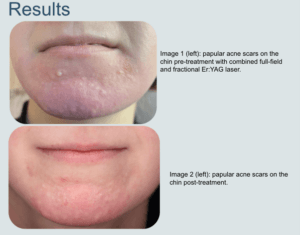
In this case, the skin surface healed within seven days and redness and swelling settled within two weeks. Our report described reduced scar prominence and smoother texture, with no adverse effects reported during two months of follow-up.
This was a single case, without a measured percentage improvement or long-term follow-up. It cannot establish how reliably the approach would work in other patients or separate the contribution of each stage. It does, however, document the treatment and outcome for a scar type with relatively little published evidence.
A different skin tone, previous pigmentation after inflammation or a history of abnormal scarring could change the treatment plan. The height and distribution of the scars also matter, as does the presence of depressed scars elsewhere. Another patient might need a different technique, more limited treatment or a staged approach.
For anyone considering treatment, the starting point is an assessment of the scars and the skin around them, followed by a discussion of what can reasonably be improved and what recovery will involve. Further information about acne-scarring assessment and treatment at Self London is available on our treatment page.
References
- Ali FR, Kirk M, Madan V. Papular acne scars of the nose and chin: an under-recognised variant of acne scarring. Journal of Cutaneous and Aesthetic Surgery. 2016;9:241–243. PubMed.
- Lee YJ, Lee CY, Shin MK. A neglected acne scar type: papular acne scars and their correlations with keloid scars. Dermatologic Surgery. 2021;47:1347–1351. PubMed.
- Lee SJ, et al. The pinhole method using an erbium laser for the treatment of papular acne scars. Dermatologic Therapy. 2017;30. DOI.
- Fonseka S, Wickramaarachchi DC, Bandara DD. Ablative carbon dioxide laser treatment for papular scars of nose and chin due to acne: a case series. International Journal of Dermatology and Venereology. 2021;4:182–184. DOI.
- Huang B, et al. Efficacy and adverse reactions of fractional CO₂ lasers for treating papular acne scars: a retrospective study of 35 patients. Lasers in Medical Science. 2024;39:246. DOI.
- Mullin J, Mahto A. BC08 Effective treatment of papular acne scarring with combined full-field and fractional Er laser resurfacing: a case report. British Journal of Dermatology. 2025;193(Supplement 1).221. Conference abstract. DOI.
- Utley DS, Koch RJ, Egbert BM. Histologic analysis of the thermal effect on epidermal and dermal structures following treatment with the superpulsed CO₂ laser and the erbium laser: an in vivo study. Lasers in Surgery and Medicine. 1999;24:93–102. PubMed.
- Sciton. ProFractional. Manufacturer technical information. Device information.