 Written by Dr Anjali Mahto
By Dr Anjali Mahto, FRCP, Consultant Dermatologist and Founder of Self London.
The answer can range from virtually none to several weeks, depending on the procedure.
Key takeaways
- Some treatments allow patients to return to their normal activities immediately, while others involve redness, swelling and peeling.
- More intensive resurfacing may require one or two weeks of wound care, with residual redness lasting considerably longer.
- The same device can be used at different depths, densities and energy settings, with substantial differences in the amount of tissue injury and subsequent recovery.
- These are general recovery estimates, not guarantees or treatment-specific aftercare instructions.
- There is also a difference between biological healing and social downtime.
- An intact skin surface is not necessarily the same as a fully recovered skin barrier.
One of the questions I am asked most frequently by patients considering laser treatment is how much downtime they should expect. The answer can range from virtually none to several weeks, depending on the procedure. Some treatments allow patients to return to their normal activities immediately, while others involve redness, swelling and peeling. More intensive resurfacing may require one or two weeks of wound care, with residual redness lasting considerably longer.
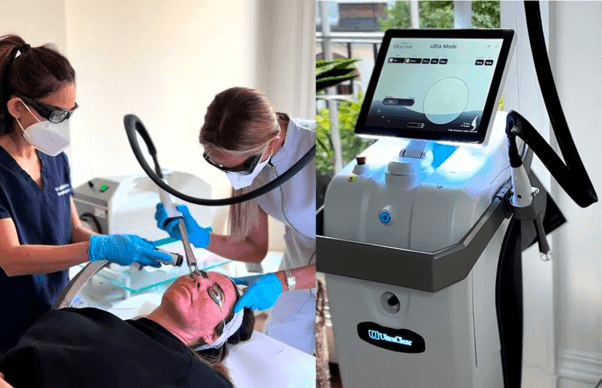
At Self London, we use a range of laser and light-based technologies, from gentle non-ablative treatments such as ClearSilk through to fractional and full-field ablative resurfacing. We also use AviClear for active acne and broadband light for pigmentation and vascular changes. Having different technologies available allows us to treat several concerns, sometimes within the same treatment plan, while varying the intensity and depth of treatment according to what the skin actually requires.
What patients may not appreciate is that the name of a laser does not tell you precisely what treatment has been performed. The same device can be used at different depths, densities and energy settings, with substantial differences in the amount of tissue injury and subsequent recovery. Two clinics may own identical machines but deliver quite different treatments. This has implications not only for downtime but also for the degree of improvement that can realistically be expected.
Understanding the biology of wound healing, and how it is influenced by the treatment selected, is useful for anyone considering laser dermatology.
How much downtime should I expect?
There is no single recovery period that applies to all laser treatments. Some technologies heat tissue while largely preserving the upper layer or epidermal barrier, whereas others deliberately remove parts of the epidermis or dermis. Broadband light and certain lasers primarily target pigment or blood vessels, while ablative resurfacing relies on controlled tissue removal and the subsequent wound-healing response.
The table below provides an indication of recovery following some of the technologies available at Self London.
| Treatment | Typical visible recovery | What patients may experience |
|---|---|---|
| ClearSilk | Usually no significant downtime | Temporary warmth or mild redness, generally settling within hours |
| AviClear | Usually minimal downtime | Temporary redness, swelling or sensitivity. Some patients experience an acne flare following treatment |
| BBL HEROic | Usually minimal downtime | Redness or mild swelling; treated brown pigmentation may temporarily darken before clearing |
| UltraClear 3D MIRACL | Often a few days, depending on the treatment settings | Redness, dryness, roughness or fine peeling |
| Halo | Commonly around 3–7 days | Redness, swelling, bronzing, roughness and subsequent shedding |
| UltraClear fractional resurfacing or ProFractional | Several days to over a week, potentially longer following intensive treatment | Redness, swelling, peeling or crusting; deeper procedures may require structured wound care |
| Contour TRL full-field ablative resurfacing | Often approximately 1–2 weeks for initial surface healing, sometimes longer | Swelling, oozing and crusting, followed by newly healed pink or red skin. Redness can persist for weeks or months |
These are general recovery estimates, not guarantees or treatment-specific aftercare instructions. Actual downtime varies with treatment parameters, anatomical location, skin characteristics, combinations of procedures and individual healing. The ranges should also be confirmed against the particular protocols being used at Self London.
BBL HEROic is broadband light rather than a laser, but it is included because it forms part of our approach to skin rejuvenation, pigmentation and vascular concerns. AviClear has a different purpose again, using 1726 nm laser energy to target sebaceous gland activity in acne. Although the surface recovery is usually relatively straightforward, the clinical response of acne develops over time and should not be confused with the period of post-treatment redness or swelling.
It is important to distinguish between three stages of recovery: the time taken for the skin surface to heal, the time taken for visible redness or other treatment effects to settle, and the time required to see the eventual clinical result. These are not interchangeable. A patient may have fully re-epithelialised after an ablative procedure but remain pink or red for several weeks, while further changes in collagen and skin texture continue over subsequent months.
There is also a difference between biological healing and social downtime. Someone whose skin has closed may no longer require intensive wound care but may still prefer not to attend work or social occasions because of visible redness. Conversely, a patient undergoing a gentler procedure may feel comfortable returning to work immediately, even though mild treatment-related changes remain visible. This is particularly important when planning laser treatment around holidays, weddings or professional commitments.
Understanding how skin heals after laser treatment
Skin healing involves overlapping stages of inflammation, tissue repair and remodelling. The nature and extent of the injury produced by a laser determine how these processes develop, and consequently how long recovery takes.
Immediately after treatment, inflammatory pathways are activated in response to the controlled tissue injury. Blood vessels dilate, chemical mediators are released and immune cells participate in clearing damaged material and initiating repair. Clinically, this can appear as warmth, redness and swelling. Following a gentle non-ablative treatment, the response may be mild and short-lived. After deeper ablative resurfacing, inflammation is more pronounced because tissue has been physically disrupted or removed.
Where the epidermis has been damaged, the skin must restore its protective barrier through a process called re-epithelialisation. Keratinocytes, the predominant cells of the epidermis, migrate and proliferate across the treated surface until it is covered by new skin. The speed of this process depends on the depth of injury, the amount of surviving tissue and how the laser has distributed that injury across the treatment area.
Fractional resurfacing creates microscopic treatment zones separated by areas of relatively intact skin. These intervening areas, together with surviving structures such as hair follicles, provide cells that contribute to repair. This helps explain why fractional treatments can produce injury within the dermis while allowing relatively rapid surface healing.
Full-field ablative resurfacing removes tissue across the entire selected surface, rather than leaving regularly spaced areas of intact epidermis. Re-epithelialisation therefore relies more heavily on surviving skin appendages and cells migrating from the wound margins. The depth of tissue removal and the amount of residual thermal injury influence the inflammatory response and subsequent healing. Full-field resurfacing is not one uniform procedure, however. A superficial Er:YAG treatment and a much deeper procedure can have very different recoveries even when performed using the same platform.
Anatomical location also needs to be considered. The face generally has a higher density of pilosebaceous (hair follicle and its associated oil gland) structures than the neck or body, contributing to its capacity for re-epithelialisation. Skin thickness, vascular supply and underlying anatomical structures also differ. Treatment settings that may be appropriate for the cheeks cannot simply be transferred to the eyelids, neck or other body areas without accounting for these differences.
Once the epidermis has healed, repair continues within the deeper dermis. Cells which produce collagen known as fibroblasts participate in the production and reorganisation of collagen and other components of the extracellular matrix. This process contributes to longer-term changes in skin texture, wrinkles and scarring, and can continue for several months after treatment.
This needs to be taken into account when assessing acne scarring. Immediately after resurfacing, swelling may temporarily make scars appear less noticeable. As the swelling settles, the scars can become more apparent again, even though healing is progressing normally. The final response cannot reliably be judged after a week or two because dermal remodelling is still taking place.
What happens during the first days and weeks?
Following intensive ablative resurfacing, the first 24–48 hours commonly involve redness, swelling, warmth, discomfort and sometimes oozing from the treated surface. Swelling may be especially noticeable around the eyes and can increase during the first couple of days. Some clear or pale yellow fluid can form part of normal early wound healing, although changes in discharge accompanied by increasing pain, heat, redness or other concerning symptoms require assessment.
During approximately days three to five, swelling and discomfort may begin to settle, although the skin can still appear inflamed. Depending on the depth of treatment and the wound-care approach used, there may be crusting, peeling or areas that have not yet fully re-epithelialised. Patients should not pick at crusts or forcibly remove peeling skin because doing so can disrupt the developing epidermis and increase the risk of infection, pigmentary changes or scarring.
Between approximately days five and ten, many patients undergoing ablative resurfacing will have made substantial progress towards re-epithelialisation, although deeper or more extensive procedures can take longer. The newly healed surface often looks pink or red and may remain unusually sensitive. Even once the wound has closed, the skin barrier may not have recovered its normal function, which is why skincare needs to remain relatively gentle.
Over the following weeks, redness, dryness and sensitivity generally diminish, but this process varies considerably. After more intensive resurfacing, erythema or redness may persist for weeks or months without necessarily indicating abnormal healing. Some patients develop post-inflammatory hyperpigmentation as the initial inflammation settles, particularly where they have a history of pigmentation following skin injury. Changes in pigment can become apparent after the surface has healed rather than during the initial recovery period.
Remodelling within the dermis continues over subsequent months. Improvements in texture and scarring may become more apparent during this time, although the degree and timing of improvement vary with the original problem and treatment technique.
These stages are most relevant to substantial ablative resurfacing. They do not describe the recovery from ClearSilk or AviClear, which ordinarily preserve the epidermal surface, or necessarily the recovery from a low-intensity fractional procedure. A patient should always be given expectations appropriate to the actual treatment performed rather than a generic timetable for laser healing.
Why the device alone does not determine the treatment
Modern laser platforms offer considerable flexibility, but the available settings are not interchangeable controls and their effects cannot be compared directly across devices. Understanding how they influence tissue injury requires knowledge of laser-tissue interactions, anatomy and wound healing, alongside experience with the particular technology.
Different wavelengths are absorbed by different components of the skin, including melanin, haemoglobin and water. This determines the primary treatment target and influences how energy is distributed. Pulse duration, fluence, beam characteristics and the way energy is delivered further affect the resulting tissue response. A laser used for vascular redness does not work in the same way as an ablative resurfacing laser, even though both are described as laser treatments.
With ablative resurfacing, the depth of tissue removal and amount of residual thermal injury are particularly important. Some systems allow the intended ablation depth to be selected, while others involve a more complex relationship between energy, pulse characteristics and tissue effects. Residual coagulation can influence haemostasis, inflammation and remodelling, but greater thermal injury may also prolong recovery or increase the risk of complications. Treatment depth on one laser platform cannot automatically be translated into an equivalent setting on another.
Fractional density is another variable. This describes the proportion of skin exposed to microscopic treatment zones. Increasing density may increase cumulative tissue injury while reducing the amount of relatively unaffected tissue between those zones. Depth and density therefore need to be considered together, particularly when treating patients with a tendency towards post-inflammatory hyperpigmentation.
The number of passes, anatomical coverage and treatment technique further influence recovery. Established acne scarring may require greater intensity in selected areas, while adjacent skin with relatively little textural damage may not benefit from the same degree of injury. Similarly, the depth and distribution of treatment may need to change around delicate structures or on areas with different healing characteristics.
Skin phototype and previous inflammatory responses must also inform treatment planning. Patients with more heavily pigmented skin may have a higher risk of post-inflammatory hyperpigmentation, but this does not mean they cannot undergo laser resurfacing. Their individual pigmentation history, underlying skin condition, previous treatment response and the anticipated inflammatory burden all need to be considered. Pigmentary complications can also occur in lighter skin, and inflammation is not the only factor influencing risk.
These decisions are made before and during treatment. Knowing how to operate a laser is one part of the procedure; understanding which technology is appropriate, how much tissue injury is justified, when to adjust the treatment and when further injury is unlikely to provide additional benefit is equally important. Clinical experience also matters when planning aftercare and recognising complications.
An important misconception is that having a recommendation for a particular laser means the patient will receive an equivalent treatment wherever that device is available. A recommendation for a laser platform is not a standardised prescription that can be taken to another clinic with the expectation of an identical procedure or result.
Two clinics may own the same machine but choose different treatment settings, depths, densities, anatomical coverage or numbers of passes. The clinician’s experience, treatment strategy, assessment of risk and approach to postoperative care may also differ. These differences can alter both the degree of improvement and the recovery that follows.
This is particularly relevant when a patient seeks an assessment and treatment recommendation from one clinician but subsequently undergoes the procedure elsewhere. The original recommendation was made in the context of an individual assessment and proposed treatment plan. Another practitioner must undertake their own assessment and clinical decision-making, and the treatment they deliver may be substantially different. The first clinician cannot determine or guarantee the settings, technique, aftercare or results of a procedure performed independently by another provider.
Patients should therefore consider who will perform their treatment, their experience with the particular device and clinical indication, how the procedure will be tailored, what improvement is realistic and what arrangements are in place for follow-up and the management of complications. Comparing the name of the machine or the price of an appointment does not answer these questions.
Can gentle treatments give the same results as deeper resurfacing?
Patients understandably want substantial improvement without a prolonged recovery, but laser treatments produce different biological effects. A gentle non-ablative procedure cannot automatically be expected to reproduce the structural changes of deeper ablative resurfacing, however many sessions are performed.
Non-ablative treatments can be useful for selected vascular concerns, early changes in skin quality and aspects of skin ageing. They are often suitable for patients who cannot accommodate significant downtime, and repeated sessions may produce gradual, cumulative improvements. More established wrinkles, deeper textural irregularities and certain types of acne scarring may require a different degree or pattern of dermal treatment to achieve a worthwhile improvement.
However, deeper treatment is not always preferable. If a patient’s main concern is facial redness, an appropriately selected vascular treatment may be more relevant than ablative resurfacing. Similarly, superficial pigmentation does not automatically justify deeper tissue injury, particularly in someone with an increased risk of post-inflammatory pigmentary change.
There is no reliable formula by which a particular number of gentle treatments can be considered equivalent to one more intensive procedure. The two approaches may address different clinical endpoints and produce different tissue responses. Patients should therefore understand what a treatment can reasonably achieve before deciding how much downtime they are prepared to accept.
The objective is to match the type and intensity of treatment to the underlying problem. Some patients prefer a gradual approach with limited interruption to everyday life, while others are willing to undergo more intensive resurfacing for the possibility of greater improvement in established damage. Both can be appropriate, provided the expectations are realistic and the risks have been properly considered.
Why we sometimes combine laser treatments
Skin ageing and skin disease rarely involve only one change. A patient may have brown pigmentation, facial redness, enlarged pores, fine wrinkles and early laxity, all of which involve different structures and biological processes within the skin. Someone with active acne may also have persistent post-inflammatory redness, while another patient may have relatively good skin quality across most of the face but more significant scarring or wrinkles in a particular area.
Having access to multiple technologies allows us to combine treatments that target different concerns, act at different depths or vary the intensity of resurfacing across anatomical areas. These combinations are sometimes described as treatment stacking, although the term can make the process sound simpler than it is.
For a patient with suitable pigmentation and textural concerns who wants relatively little downtime, we may combine ClearSilk with UltraClear 3D MIRACL. Where more extensive photodamage is present, including brown pigmentation and vascular changes, BBL HEROic may also be incorporated. The diagnosis matters here, because solar lentigines, melasma and post-inflammatory hyperpigmentation have different underlying mechanisms and cannot all be approached in the same way. Even when several technologies are used, the settings and treatment sequence are selected to avoid unnecessary cumulative injury.
In patients with active acne and persistent redness, we may use AviClear to address sebaceous gland activity, together with BBL HEROic for appropriate vascular changes. ClearSilk may also be included in selected patients, depending on their skin and the problems being treated. Treating acne itself and addressing the redness that accompanies or remains after inflammation are different objectives. The technologies may be combined within a treatment programme, but they do not necessarily need to be delivered during the same appointment.
Different forms of resurfacing can also be used together. Someone with established acne scarring or pronounced perioral wrinkles may benefit from localised full-field ablative resurfacing in areas requiring more intensive treatment, alongside fractional ablation in other areas. This allows us to vary the depth and extent of injury rather than applying the same treatment across the entire face. Recovery may consequently differ from one area to another, with the more intensively treated skin requiring longer to re-epithelialise.
A patient concerned about ageing around the eyes as well as more general facial photodamage may be assessed for targeted laser coring of suitable eyelid skin, alongside BBL HEROic and Halo for broader rejuvenation. Treatment close to the eyes requires particular care because of the anatomy, the need for appropriate ocular protection and the potential consequences of excessive tissue injury. Eyelid treatment is not suitable for everyone, and the different components may be better performed in stages.
These examples illustrate why recovery cannot be predicted simply by counting the number of devices used. Combining relatively gentle treatments may involve little additional visible downtime, whereas incorporating localised full-field ablation into a broader fractional resurfacing plan creates areas with different healing requirements. The cumulative inflammatory response, treatment density, depth, anatomical location and individual pigmentation risk all influence how the skin recovers.
Combination treatments are not automatically superior to a single procedure. Each technology should have a clear purpose, and the additional benefit must justify any increase in recovery or potential complications. Although published studies support selected combinations of light-based and fractional technologies, this does not mean that every possible combination has been evaluated in controlled clinical trials. Some approaches are based on the known tissue effects of the devices and the treating clinician’s experience.
For us, the advantage of having several platforms available is that we can select treatments according to the patient’s skin rather than expecting one device to address every concern. Sometimes that involves several technologies, while in other cases one well-chosen treatment is sufficient.
Practical recovery: skincare, make-up, exercise and everyday activities
One of the difficulties with advice about laser recovery is that restrictions appropriate for an open ablative wound are not necessarily relevant to a gentle non-ablative procedure. It is therefore misleading to give every patient the same list of instructions or a universal timetable for returning to normal activities.
The following guidance explains the principles involved. It is not a substitute for the written aftercare instructions supplied after an individual procedure, which should always take precedence.
Cleansing and moisturising. Following a gentle treatment that leaves the skin surface intact, patients can often return to a simple skincare routine relatively quickly, using a mild cleanser and moisturiser if appropriate. More intensive ablative resurfacing requires a different approach because the epidermal barrier has been disrupted. Patients may be instructed to perform regular soaks or gentle cleansing and apply an appropriate ointment to maintain a suitable healing environment. The products used, frequency of cleansing and need for dressings depend on the procedure. Wound care should follow the treating clinician’s instructions rather than advice intended for a different laser.
Make-up. After some non-ablative treatments, make-up may be worn relatively soon, provided the skin is intact and not significantly irritated, although individual protocols may impose a short waiting period. Following ablative resurfacing, make-up should not be applied to an open, oozing or incompletely re-epithelialised area. Once the surface has healed and the clinician has confirmed it is appropriate, gentle, non-irritating products may be used to camouflage persistent redness. Make-up brushes, applicators and removal techniques also need to be considered because newly healed skin is more easily irritated.
Exercise and sweating. Patients having minimal-downtime treatments may be able to resume their usual activities relatively quickly, although strenuous exercise, excessive heat and heavy sweating are often avoided initially to minimise irritation and swelling. Following deeper resurfacing, vigorous exercise may need to be postponed until the skin has healed sufficiently. Heat, sweat and friction can aggravate inflamed skin, while activities that expose an open wound to contamination should be avoided. The point at which exercise can safely be resumed depends on the treatment and the progress of healing rather than a fixed number of days.
Swimming, saunas and steam rooms. These should generally be avoided while the skin is open, crusted or actively peeling after ablative treatment. Swimming pools, hot tubs and other shared water environments introduce additional considerations around irritation and infection. Heat from saunas and steam rooms can also exacerbate redness and swelling. Patients should wait until the skin has healed and their treating clinician has confirmed that these activities are appropriate.
Retinoids, exfoliating acids and active skincare. Products containing retinoids, alpha- or beta-hydroxy acids and other potentially irritating ingredients are commonly withheld around resurfacing procedures. They should not be restarted simply because the visible peeling has finished. Newly healed skin may remain sensitive and have an incompletely recovered barrier, so reintroducing active ingredients too early can provoke irritation and further inflammation. The timing should be individualised, with longer delays often necessary after more intensive treatment.
Sun exposure and photoprotection. Ultraviolet exposure is an important consideration before and after laser treatment, particularly in patients prone to pigmentation. Strong sun exposure should be avoided during healing, and protective measures need to continue after the surface has recovered. Once the skin is intact and suitable products can be applied, a broad-spectrum sunscreen with high UVA protection, generally SPF 50 or 50+, is appropriate alongside shade and protective clothing. Sunscreen should not be applied indiscriminately to open or oozing wounds; during that stage, the wound-care plan and physical avoidance of sun exposure take priority. Ongoing photoprotection is important both to reduce complications and to preserve improvements in sun damage.
Shaving, waxing and other skin treatments. Friction and mechanical disruption should be avoided while the treated area is healing. Shaving may need to be delayed, especially after ablative procedures, while waxing, depilatory products, exfoliation and further aesthetic treatments should not be resumed until the skin is ready. These activities can produce additional injury in skin that is already inflamed or recovering.
Travel, work and social commitments. Patients considering intensive resurfacing should plan for more than the minimum expected time required for wound closure. Even if re-epithelialisation occurs relatively quickly, visible redness, swelling and sensitivity may continue. Travel can also complicate access to postoperative review, particularly if healing is slower than expected or a complication develops. Treatments should therefore be planned with sufficient time for recovery, follow-up and the possibility that healing takes longer than anticipated.
Following more intensive resurfacing, patients may be prescribed antiviral medication or other treatments according to their medical history, the procedure performed and the clinician’s assessment of infection risk. These medications should be taken as directed, and patients should not change or stop them because the skin appears to be healing faster than expected.
An intact skin surface is not necessarily the same as a fully recovered skin barrier. Patients may still experience dryness, sensitivity, irritation or altered pigmentation after the visible wound has closed. These changes should inform the gradual return to normal skincare and activities.
What is normal during recovery, and when should I be concerned?
Redness, swelling, warmth, peeling and sensitivity are common after laser treatment, although their severity and duration depend on the type of procedure. Following more intensive ablative resurfacing, the newly healed skin may remain pink or red for a prolonged period without this necessarily indicating a complication. What matters is whether the recovery is progressing as expected for the treatment performed.
Increasing pain, heat, swelling or redness after an initial period of improvement is more concerning than symptoms that are gradually settling. New or increasing discharge, pus, an unpleasant odour, fever, unusual blisters or areas of skin breakdown also require assessment. Clusters of painful blisters or erosions can indicate herpes simplex reactivation, which is a recognised complication following resurfacing. Significant or persistent itching may reflect irritation or contact dermatitis, but should not automatically be assumed to be harmless, particularly if accompanied by worsening inflammation.
Delayed re-epithelialisation requires particular attention because prolonged open wounds may be associated with infection or an increased risk of scarring. The expected healing period depends on the depth and extent of the procedure, so an area that is healing normally after one treatment may be unusually slow after another. Patients should contact their treating clinic if they are uncertain rather than waiting for a routine review.
Potential complications include bacterial and viral infection, contact dermatitis, persistent erythema, post-inflammatory hyperpigmentation, hypopigmentation and scarring. More severe complications are uncommon but can occur, including after treatment by experienced clinicians. Risk is influenced by the procedure, anatomical location, individual healing characteristics, underlying skin disease and postoperative care. Some changes in pigmentation appear after the initial wound has healed, meaning that the absence of early problems does not guarantee an entirely uncomplicated recovery.
Any significant eye pain, visual disturbance or new visual symptoms following treatment near the eyes requires urgent medical assessment. Severe, rapidly worsening symptoms or systemic illness should not be left until the next scheduled follow-up appointment.
Recognising and managing complications is part of procedural dermatology. In particular, deeper resurfacing requires appropriate patient selection, detailed counselling, structured wound care and access to postoperative review. At Self London, patients undergoing intensive ablative procedures receive individualised written aftercare instructions and arrangements for clinical follow-up. Wound management is part of the treatment rather than something separate from the laser procedure itself.
When will I see the final results, and will I need another treatment?
The timing of improvement depends on the structures being treated and the biological response being sought. Pigmentary and vascular changes may become apparent as the initial reaction settles over days or weeks, whereas changes in wrinkles, texture and scarring generally take longer because they involve tissue remodelling. Some treatments, including AviClear, are intended to influence an underlying disease process rather than produce an immediate resurfacing effect, so the timeline for clinical improvement is different from the timeline for visible recovery.
Following deeper resurfacing, the final degree of improvement may not be apparent for six months. Early swelling can temporarily change the appearance of scars and fine lines, and the subsequent reduction in swelling should not be mistaken for treatment failure. Equally, not every scar or wrinkle will improve to the same extent. Some patients benefit from additional procedures, particularly where there are different scar types or more significant tissue changes, and complete correction cannot be guaranteed.
Even after successful resurfacing, the skin continues to age. Collagen, elastin and other components of the extracellular matrix change over time, while ultraviolet exposure, hormonal changes, genetics and environmental factors continue to affect the skin. A treatment may produce lasting improvement in existing wrinkles, scars or photodamage without preventing new changes from developing in subsequent years.
Patients may therefore choose further treatment in the future, either to maintain previous improvements or address new concerns. This does not mean that everyone requires regular procedures indefinitely. The need for additional treatment depends on the original problem, the response achieved, subsequent ageing and the individual’s preferences. There is no universal maintenance schedule, and repeat treatment should have a clear clinical purpose.
At Self London, the starting point is an assessment of the patient’s skin, the changes they wish to address and the degree of improvement that is realistic. We consider whether a gentle procedure, more intensive resurfacing or a combination of technologies is appropriate, alongside the recovery and risks involved.
Laser treatment is not simply the application of a named device to the skin. The diagnosis, treatment plan, parameters selected, technique and postoperative management all influence the outcome. Understanding these factors is essential for patients making informed decisions about both the treatment itself and where they choose to have it performed.
This article provides general educational information about recovery from laser and light-based skin treatments. It does not replace an individual clinical assessment, written postoperative instructions or advice from the practitioner responsible for a patient’s procedure. Recovery and the suitability of activities and skincare vary between people and between treatment settings.
References
- Kang BY et al. Consensus Statement on the Prevention and Management of Complications of Fully Ablative Laser Resurfacing of the Face. Lasers in Surgery and Medicine. 2025. https://doi.org/10.1002/lsm.70035
- Expert Consensus on Clinical Recommendations for Fractional Ablative CO₂ Laser in Facial Skin Rejuvenation Treatment. Lasers in Surgery and Medicine. https://doi.org/10.1002/lsm.23850
- Ablative Laser Resurfacing. StatPearls. National Center for Biotechnology Information. https://www.ncbi.nlm.nih.gov/books/NBK557474/
- Expert Recommendations on Supportive Skin Care for Non-Surgical and Surgical Procedures. Journal of the European Academy of Dermatology and Venereology. https://doi.org/10.1111/jdv.18855
- Complications of Laser and Energy-Based Procedures in Dermatology: Classification, Management, and Prevention. Journal der Deutschen Dermatologischen Gesellschaft. 2026. https://doi.org/10.1111/ddg.70102
- American Society of Plastic Surgeons. Laser Skin Resurfacing: Recovery. https://www.plasticsurgery.org/cosmetic-procedures/laser-skin-resurfacing/recovery
- Leeds Teaching Hospitals NHS Trust. After Your Laser Treatment. Patient information, reviewed May 2025. https://www.leedsth.nhs.uk/patients/resources/after-your-laser-treatment/