 Written by Dr Anjali Mahto
By Dr Anjali Mahto, Consultant Dermatologist with a clinical focus on laser treatments and acne scarring, and founder of Self London.
Vertical lip lines are a common feature of facial ageing, including in people who have never smoked. Dr Anjali Mahto, Consultant Dermatologist and Founder of Self London, explains why these wrinkles develop, what happens to the skin as we age, and how laser resurfacing can improve their appearance without adding volume to the lips.
Key takeaways
- These wrinkles are known medically as perioral rhytides, although they are often called vertical lip lines, lipstick lines or smoker’s lines.
- Dermatologists distinguish between dynamic wrinkles, which appear mainly during muscular contraction, and static wrinkles, which remain visible when the face is relaxed.
- For patients whose main concern is the texture of the skin above the upper lip, the problem may lie predominantly within the dermis rather than in the volume of the lip itself.
- Ablative laser resurfacing has been used for decades to improve facial wrinkles, scars and skin texture.
- Laser resurfacing can produce substantial improvements in perioral wrinkles, particularly when the lines are static and associated with changes in the skin itself. Complete removal, however, cannot be guaranteed.
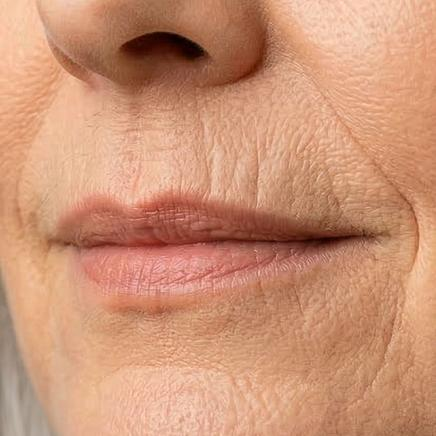
Fine lines around the mouth can be particularly frustrating because they often become noticeable before other signs of facial ageing. Initially, they may only appear when speaking, smiling or pursing the lips. Over time, they become visible even when the face is relaxed. Lipstick may begin to collect in them, and the skin immediately above the upper lip can develop a finely creased appearance.
These wrinkles are known medically as perioral rhytides, although they are often called vertical lip lines, lipstick lines or smoker’s lines. Smoking can accelerate their development, but the term is misleading because many people who develop them have never smoked.
The mouth is a relatively small anatomical area, yet its ageing involves changes in the skin, muscle, fat and underlying bone. These structures do not all change in the same way or at the same rate, which helps explain why treating wrinkles around the mouth is sometimes more difficult than it appears.
Although dermal fillers are frequently suggested, adding volume is not necessarily the most appropriate approach for someone whose main concern is fine wrinkles in the skin. Laser resurfacing provides an alternative by treating the skin itself, with the potential to improve established lines while preserving the natural shape of the lips.
Why do fine lines develop around the mouth?
The skin around the mouth is repeatedly stretched, compressed and folded throughout the day. Much of this movement is produced by the orbicularis oris, a circular muscle surrounding the opening of the mouth that is involved in speech, eating, drinking and facial expression.
When the orbicularis oris contracts, the overlying skin folds in a direction roughly perpendicular to the muscle fibres. This is why many wrinkles above the upper lip are vertical rather than horizontal.
In younger skin, the folds generally disappear when the muscle relaxes. The skin is sufficiently resilient to return to its original position because of the structural proteins and surrounding material within the dermis.
Two of the most important proteins are collagen and elastin. Collagen provides tensile strength, allowing the skin to resist mechanical forces, while elastin contributes to its ability to stretch and recover its shape. Both form part of the extracellular matrix, the network of proteins and other molecules that supports the cells within the skin.
As we age, the arrangement and integrity of these fibres change. Collagen becomes increasingly fragmented, elastic fibres deteriorate and fibroblasts, the cells responsible for maintaining much of the extracellular matrix, become less effective.
This has important mechanical consequences. When collagen fibres are fragmented, they provide less resistance to deformation. Fibroblasts also depend on their attachment to the surrounding matrix to maintain normal function. As that mechanical support deteriorates, collagen production can decline further while the activity of collagen-degrading enzymes increases.
Repeated facial movement is therefore occurring in skin that has gradually become less capable of recovering from it. Eventually, a crease that once appeared only during movement can become permanently established.
Dermatologists distinguish between dynamic wrinkles, which appear mainly during muscular contraction, and static wrinkles, which remain visible when the face is relaxed. Both may be present around the mouth, but they respond differently to treatment.
How does sun exposure affect wrinkles around the lips?
Ultraviolet radiation from the sun is one of the most important external contributors to skin ageing. Repeated exposure damages collagen and elastic fibres, accelerates changes in the dermis and reduces the skin’s ability to maintain its normal structure.
One of the mechanisms involves the generation of reactive oxygen species, which activate cellular signalling pathways associated with inflammation and tissue damage. These pathways increase the production of enzymes called matrix metalloproteinases, which degrade components of the extracellular matrix, including collagen.
Ultraviolet radiation can also interfere with the synthesis of new collagen. Over time, the combination of increased breakdown and reduced replacement produces the characteristic changes of photoaged skin.
In the upper dermis, abnormal elastin-rich material can accumulate, a process known as solar elastosis. Despite this accumulation, the skin becomes less elastic because the normal architecture of its elastic fibre network has been disrupted.
The result is skin that wrinkles more readily and is less able to recover its shape after movement. Around the mouth, where the skin is repeatedly folded throughout the day, these changes become particularly apparent.
Cumulative sun exposure is therefore an important reason why two people of the same age may have very different degrees of perioral wrinkling. Smoking produces additional damage through oxidative stress and changes in the skin’s connective tissues. Repeated lip pursing may also contribute, although ordinary facial movement is sufficient for vertical lip lines to develop.
Hormonal changes can play a role as well. Oestrogen influences dermal collagen, hydration and skin thickness, and its decline around menopause may contribute to increased wrinkling. However, menopause does not affect everyone in the same way, and changes in the skin reflect the combined effects of age, genetics, ultraviolet exposure and individual anatomy.
Do lips lose volume as we age?
It is commonly assumed that the ageing upper lip becomes wrinkled simply because it loses volume. The anatomical changes are more complicated, and research has challenged the idea that volume loss alone explains the appearance of an older lip.
With age, the upper lip often becomes longer and flatter. The visible red portion of the lip, known as the vermilion, may appear smaller, while the border between the vermilion and surrounding skin becomes less defined. Changes in the underlying maxillary bone, muscle and soft tissues can also affect lip projection.
Researchers have investigated these changes using photography, magnetic resonance imaging and histological examination of tissue. A 2009 study published in Plastic and Reconstructive Surgery examined sections of the upper lip from 20 individuals in two age groups, comparing people younger than 40 with those older than 80. The investigators found thinning of the skin and orbicularis oris muscle, degeneration of collagen and elastic fibres, and changes in the angle of the muscle at the vermilion border.
Their findings supported the theory that loss of elasticity, altered muscle architecture and changes in tissue position contribute to the appearance of the ageing lip, rather than a simple reduction in total tissue volume.
These studies are relatively small and cannot explain every feature of perioral ageing, but they are relevant to treatment selection. A lip that looks flatter or more wrinkled with age does not necessarily require more volume. For patients whose main concern is the texture of the skin above the upper lip, the problem may lie predominantly within the dermis rather than in the volume of the lip itself.
Why might filler not be the best treatment for lip lines?
Hyaluronic acid dermal fillers are useful when changes in lip volume, projection or structural support contribute to a patient’s concerns. They can also soften some wrinkles when carefully placed.
However, fine vertical lines around the mouth frequently reflect degeneration of the dermal collagen and elastic fibre networks. Adding volume beneath these lines does not directly remove the damaged tissue or correct the surface of the skin.
Filler may improve some creases by supporting or gently stretching the overlying tissue, but treating numerous fine wrinkles by progressively adding volume can alter the proportions of the upper lip. This may be particularly undesirable for someone who is happy with the size and shape of their lips.
This is important because many patients seeking treatment for vertical lip lines do not want larger lips. They want the skin above the mouth to look smoother, with less visible creasing at rest and fewer lines into which lipstick can settle. For these patients, a treatment that improves the skin itself may be more appropriate than one designed primarily to replace volume.
Can retinol or tretinoin get rid of lip wrinkles?
Skincare is useful for preventing further photodamage and improving early signs of ageing, although it is less effective at correcting deeply established wrinkles.
Daily broad-spectrum sunscreen helps limit the continued ultraviolet damage responsible for collagen degradation. It is worth paying particular attention to the upper lip, which is easily missed when applying sunscreen.
Topical retinoids have some of the strongest clinical evidence for the treatment of photoaged skin. Prescription tretinoin works through retinoic acid receptors within cells, influencing epidermal differentiation, collagen metabolism and the expression of enzymes involved in collagen breakdown.
A systematic review and meta-analysis published in 2025 examined eight randomised controlled trials involving 1,361 participants. It found that topical tretinoin significantly improved both fine and coarse facial wrinkles associated with photodamage compared with vehicle treatment.
These findings are encouraging, although most skincare studies assess facial photoageing more broadly rather than specifically examining deeply etched wrinkles above the upper lip. Improvements also develop gradually over months, and the degree of correction is generally more limited than that achievable with intensive resurfacing.
Moisturisers can temporarily make superficial lines less noticeable by increasing hydration of the stratum corneum, the outermost layer of the epidermis. They do not, however, reverse the deeper changes in collagen and elastin that produce established static wrinkles.
For someone with relatively early lines, good skincare may provide sufficient improvement. More pronounced wrinkles often require treatment that produces structural changes within the skin.
How does laser resurfacing work for wrinkles around the mouth?
Ablative laser resurfacing has been used for decades to improve facial wrinkles, scars and skin texture. It is particularly relevant to perioral wrinkles because it acts directly on the affected skin rather than changing the volume of the lips.
The principle involves the absorption of laser energy by water within the tissue. When sufficient energy is delivered over an appropriate period, the resulting rapid heating causes controlled vaporisation of tissue, a process known as ablation.
This allows damaged skin to be removed in a highly controlled manner. Depending on the laser system and settings, the treatment may also produce a surrounding zone of thermal injury.
Two processes contribute to the improvement in wrinkles. The first is the direct removal of tissue from the skin surface, which can reduce the depth of established creases. The second is the wound-healing response that follows treatment, during which the epidermis repairs itself and the dermis undergoes remodelling.
During healing, fibroblasts become involved in the production and reorganisation of collagen and other extracellular matrix components. These changes continue for months after the surface of the skin has healed. The extent of improvement depends on how deeply the wrinkles are established, how much tissue is treated and the degree of remodelling that follows.
This explains why treatments described collectively as laser resurfacing can produce very different results. A relatively superficial fractional procedure and an intensive fully ablative procedure may both use an erbium wavelength, but their effects on the skin, recovery periods and likely outcomes can differ considerably.
Fractional versus fully ablative laser resurfacing
Fractional resurfacing treats the skin in numerous microscopic zones separated by areas of relatively untreated tissue. The surrounding skin contributes to healing, generally allowing a faster recovery than treatment of the entire skin surface.
In ablative fractional resurfacing, microscopic columns of tissue are removed. With non-ablative fractional lasers, controlled thermal injury is produced without vaporising the skin surface.
Fractional treatment can be useful for relatively superficial perioral lines, mild crepiness and broader changes in skin texture. It may also be preferable when the patient’s skin type, medical history or tolerance for downtime makes a more intensive procedure unsuitable. However, fractional treatment does not necessarily provide the same improvement as full-field resurfacing for deeper, established wrinkles.
In full-field ablative resurfacing, the laser treats the entire selected surface rather than leaving intervening areas of untreated skin. This permits more extensive removal of damaged tissue and can produce substantial improvements in static wrinkles, particularly when the lines are deeply etched. The trade-off is a greater degree of injury, longer recovery and increased potential for complications.
Treatment intensity cannot be judged solely by whether a laser is fractional or fully ablative. Ablation depth, treatment density, the number of passes, pulse characteristics and the amount of residual thermal injury all contribute to the final tissue effect.
An intensive fractional treatment may be substantially more invasive than a light full-field procedure, although full-field resurfacing generally places greater demands on wound healing. The choice requires an assessment of the wrinkles themselves, including their depth, distribution and appearance when the face is both relaxed and moving.
Why use an Erbium:YAG laser for wrinkles above the upper lip?
The two most established ablative resurfacing lasers are the 2940 nm erbium (Er) laser and the 10,600 nm carbon dioxide (CO₂) laser. Both target water in the skin, but they differ in how efficiently their wavelengths are absorbed and the amount of surrounding thermal injury produced.
The Erbium wavelength is absorbed particularly strongly by water, allowing precise tissue ablation. With short-pulse settings, it can remove thin layers of skin while leaving relatively little residual thermal damage.
CO₂ lasers produce both ablation and a greater degree of thermal coagulation with conventional resurfacing techniques. This coagulation can contribute to tissue contraction and subsequent dermal remodelling, although excessive heating can increase the risk of prolonged redness, pigmentary changes and scarring.
Modern laser systems allow considerable variation in pulse duration, energy delivery and coagulation. Consequently, it would be inaccurate to describe all Erbium treatments as minimally thermal or all CO₂ treatments as producing excessive heat.
At Self London, we use the Sciton 2940 nm Erbium platform, which allows both fractional resurfacing with ProFractional and full-field ablative resurfacing with Contour TRL. For the upper lip, this flexibility is useful because the depth and distribution of wrinkles can vary considerably. Early creasing may require only a relatively limited degree of resurfacing, while deep static wrinkles may be better suited to a more intensive approach.
Erbium resurfacing also has published evidence specifically examining the treatment of perioral wrinkles. In a retrospective study published in Plastic and Reconstructive Surgery in 2019, Sanniec and colleagues assessed 45 patients treated for perioral rhytides, with an average follow-up of 13 months.
Photographic outcomes were evaluated by blinded plastic surgeons and non-physician assessors. The investigators reported a statistically significant improvement, averaging 2.2 grades on their wrinkle assessment scale. No hypopigmentation was recorded at the six-month assessment.
How deep does laser resurfacing need to go?
The depth of the wrinkles is one of the most important considerations when planning perioral resurfacing, although the required treatment depth cannot be determined simply by measuring the visible crease.
Fine lines may respond to relatively superficial treatment, while deeper static rhytides often require more extensive ablation and dermal remodelling.
The challenge is that the aim is not to remove the full anatomical depth of every wrinkle. Doing so could create unnecessary injury and increase the risk of scarring. Instead, resurfacing seeks to reduce surface irregularity and improve the supporting dermal architecture through a controlled healing response. Treatment must also preserve sufficient viable tissue and regenerative capacity for normal re-epithelialisation.
Several technical factors influence this balance, including the wavelength, fluence, pulse duration, spot size, treatment density, number of passes and degree of thermal coagulation. The significance of each parameter depends on the laser platform and the tissue being treated, so settings cannot simply be transferred from one device to another.
A further consideration is the clinical endpoint observed during treatment. Tissue appearance, the response to successive passes and the anatomical characteristics of the treated area all contribute to the decision about whether additional ablation is appropriate.
These judgements are particularly relevant when treating an area as small as the upper lip, where a relatively minor difference in the depth or distribution of treatment can have a significant effect on healing.
Laser resurfacing therefore requires more than selecting a device and following a standard set of settings. Understanding laser-tissue interaction, cutaneous anatomy and wound healing is central to deciding how aggressively an area can be treated and when further treatment is likely to add more risk than benefit.
Can Halo or UltraClear improve lines around the mouth?
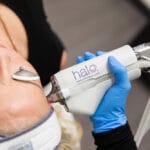
Fractional technologies such as Sciton Halo and UltraClear can also be considered for fine lines and changes in skin texture, particularly when perioral wrinkles form part of more general facial photoageing.
Halo combines 1470 nm non-ablative fractional treatment with 2940 nm ablative fractional treatment. The wavelengths create different patterns of tissue injury, allowing treatment of multiple aspects of skin texture and photodamage. UltraClear uses a 2910 nm fibre laser and provides a range of ablative fractional resurfacing options, with treatment intensity adjusted according to the clinical indication. These platforms may be appropriate for patients with relatively superficial wrinkles, fine crepiness or additional textural concerns elsewhere on the face.
There is currently insufficient high-quality comparative evidence specifically for perioral wrinkles to claim that either of these newer platforms is consistently superior to established ablative resurfacing techniques.
For this reason, the choice at Self London begins with the clinical appearance of the skin rather than the name of a laser.
What about Botox, microneedling and radiofrequency?
Botulinum toxin can improve selected dynamic wrinkles by reducing contraction of the orbicularis oris muscle. It may be useful when lines are primarily associated with movement, although its effect on deeply established static wrinkles is limited. The muscle is essential for normal lip function, so treatment requires caution. Excessive relaxation can interfere with speech, drinking and other movements of the mouth.
Microneedling produces controlled microscopic injuries that stimulate healing within the skin. Radiofrequency microneedling adds thermal energy delivered through needles, allowing targeted treatment of selected tissue depths.
These procedures can improve aspects of skin texture and fine wrinkling, although outcomes vary according to the technology and treatment protocol. They do not reproduce the same tissue effects as intensive ablative laser resurfacing, and severe static perioral wrinkles may be more difficult to correct.
Chemical peels are another option, with deeper peels capable of producing more substantial resurfacing. However, the depth of injury must be carefully controlled, and complications can include prolonged erythema, pigmentary changes and scarring.
Treatment choice ultimately depends on whether wrinkles are predominantly related to muscular movement, changes within the skin or alterations in the supporting facial anatomy. Some patients may benefit from combining approaches, although this is not always necessary.
Is laser resurfacing safe for darker skin?
Laser resurfacing can be performed in selected patients with darker skin, but pigmentary complications are an important consideration. Ablative resurfacing lasers primarily target water rather than melanin. However, the inflammation produced during treatment can stimulate melanocytes and cause post-inflammatory hyperpigmentation, leaving the treated skin darker than the surrounding area.
The risk is influenced by skin phototype, previous pigmentation problems, recent sun exposure, treatment intensity and the degree of inflammation during healing.
Hypopigmentation, where the treated skin becomes lighter, can also occur following intensive resurfacing. Although less common, it may be persistent and can be particularly conspicuous in darker skin.
Fractional treatment may reduce some of the risks associated with full-field ablation by preserving untreated areas of skin, but does not eliminate them. A more conservative treatment may also produce a smaller improvement in deep wrinkles.
Patients with a history of melasma, post-inflammatory hyperpigmentation or abnormal scarring require particular care. In some circumstances, the risk of pigmentary change may outweigh the potential improvement, and an alternative treatment or no procedure may be preferable.
The possibility of complications should be discussed before treatment, including the fact that pigmentation changes and scarring may be difficult or impossible to reverse completely.
What is recovery like after laser resurfacing around the mouth?
The recovery period depends primarily on the extent and depth of treatment.
Lighter fractional procedures may cause redness, swelling, dryness and peeling for several days. More intensive fractional resurfacing can produce a longer period of inflammation and visible healing.
Following fully ablative resurfacing, the skin initially behaves like an open wound. Swelling, redness, weeping and crusting are expected during the early healing phase, and re-epithelialisation commonly takes approximately one to two weeks, depending on the treatment performed.
The formation of a new epidermal surface does not mean that healing is complete. Redness can persist for several weeks or months after intensive resurfacing, and the underlying dermis continues to remodel long after the skin has closed.
The area around the mouth presents additional considerations because it is continually moving and is exposed to saliva, food and microorganisms. Herpes simplex reactivation is a recognised complication of ablative resurfacing, even in some patients who do not recall previously having cold sores.
Preventive antiviral medication is commonly prescribed when undertaking intensive resurfacing. Appropriate cleansing, wound care, infection prevention and clinical follow-up are also important.
At Self London, intensive ablative resurfacing is accompanied by a structured aftercare plan and monitoring during recovery. Patients are advised about the expected stages of healing, signs of potential complications and the restrictions on skincare, makeup and sun exposure during the initial recovery period.
More aggressive resurfacing can provide greater improvement in established wrinkles, but the recovery should not be underestimated. Patients need to understand both the immediate wound-healing period and the possibility of prolonged redness before proceeding.
Can laser resurfacing completely remove lip lines?
Laser resurfacing can produce substantial improvements in perioral wrinkles, particularly when the lines are static and associated with changes in the skin itself. Complete removal, however, cannot be guaranteed.
Superficial wrinkles generally respond more readily than deep, established creases. Some lines may remain visible after treatment, particularly during facial movement, and the degree of improvement depends on the depth of wrinkling, skin quality, treatment technique and individual healing.
Results also develop over time and patience is required. The skin surface heals first, while collagen remodelling continues over the subsequent months. It may take several months before the full effect of an intensive resurfacing procedure becomes apparent.
Some patients may benefit from a single treatment, whereas others may require repeated procedures or a combination of techniques. In some cases, the risks of further treatment may outweigh the likely additional improvement.
Laser resurfacing cannot prevent the natural ageing process or stop the muscles around the mouth from moving. Continued sun protection and appropriate skincare remain useful after treatment, and further lines may develop with age.
When should you consider treatment for wrinkles around the mouth?
Fine lines around the mouth are a normal feature of ageing and do not require treatment unless they are of concern to the individual. For patients who are troubled by established wrinkles, particularly those that remain visible at rest, a dermatology consultation can help establish whether the main problem lies within the skin or the underlying facial structures.
The appearance of the upper lip during movement is as important as its appearance at rest. The depth of the wrinkles, skin thickness, degree of photodamage, skin phototype and previous treatments all influence what can reasonably be achieved.
At Self London, the assessment is used to determine whether resurfacing is appropriate and, if so, which approach is most likely to produce a worthwhile improvement. For some patients, a fractional procedure may be sufficient. For others, deeper wrinkles may justify consideration of more extensive ablative treatment and its associated recovery.
For patients who wish to improve wrinkles and skin texture without changing the natural shape or fullness of their lips, laser resurfacing offers an established treatment option supported by clinical research.
References
- Grewal SK, Ortiz AE. Perioral Rejuvenation in Aesthetics: Review and Debate. Clin Dermatol. 2022;40(3):265–273. DOI: 10.1016/j.clindermatol.2021.11.010.
- Iblher N, Kloepper J, Penna V, Bartholomae JP, Stark GB. Changes in the aging upper lip: A photomorphometric and MRI-based study (on a quest to find the right rejuvenation approach). J Plast Reconstr Aesthet Surg. 2008;61:1170–1176.
- Penna V, Stark GB, Eisenhardt SU, Bannasch H, Iblher N. The aging lip: a comparative histological analysis of age-related changes in the upper lip complex. Plast Reconstr Surg. 2009;124(2):624–628. DOI: 10.1097/PRS.0b013e3181addc06.
- Iblher N, Stark GB, Penna V. The aging perioral region: do we really know what is happening? J Nutr Health Aging. 2012;16(6):581–585. DOI: 10.1007/s12603-012-0063-7.
- Sanniec K, Afrooz PN, Burns AJ. Long-Term Assessment of Perioral Rhytide Correction with Erbium Laser Resurfacing. Plast Reconstr Surg. 2019;143(1):64–74. DOI: 10.1097/PRS.0000000000005163.
- Riggs K, Keller M, Humphreys TR. Ablative laser resurfacing: high-energy pulsed carbon dioxide and erbium. Clin Dermatol. 2007;25(5):462–473. DOI: 10.1016/j.clindermatol.2007.07.003.
- Huang HY, Lee LTJ. Tretinoin for Photodamaged Facial Skin: Systematic Review and Meta-Analysis of Randomized Controlled Trials. Dermatol Pract Concept. 2025;15(4). DOI: 10.5826/dpc.1504a5172.
- Kang BY, et al. Consensus Statement on the Prevention and Management of Complications of Fully Ablative Laser Resurfacing of the Face. Lasers Surg Med. 2025;57(6):477–489. DOI: 10.1002/lsm.70035.
- Harnchoowong S, Vachiramon V, Jurairattanaporn N. Cosmetic Considerations in Dark-Skinned Patients. Clin Cosmet Investig Dermatol. 2024;17:259–277. DOI: 10.2147/CCID.S450081.