Key Takeaways
- The right laser treatment depends on the individual patient, not simply the condition or device being used.
- Diagnosis comes first because pigmentation, melasma, scarring and photodamage can require very different approaches.
- Laser settings are highly personalised, with depth, density and treatment area adjusted according to skin type, concerns and treatment goals.
- Different patients may need different technologies or treatment combinations, and in some cases a laser may not be appropriate at all.
- Clinical expertise matters as much as the technology, which is why specialist assessment is essential before treatment.
A real Self London case shows why choosing a laser is only one part of treating sun-damaged skin. Consultant Dermatologist, Dr Anjali Mahto, explains why a particular 2910 nm laser treatment was chosen for this patient, and how changes in diagnosis, scarring, skin type or the degree of ageing could have resulted in a completely different plan.
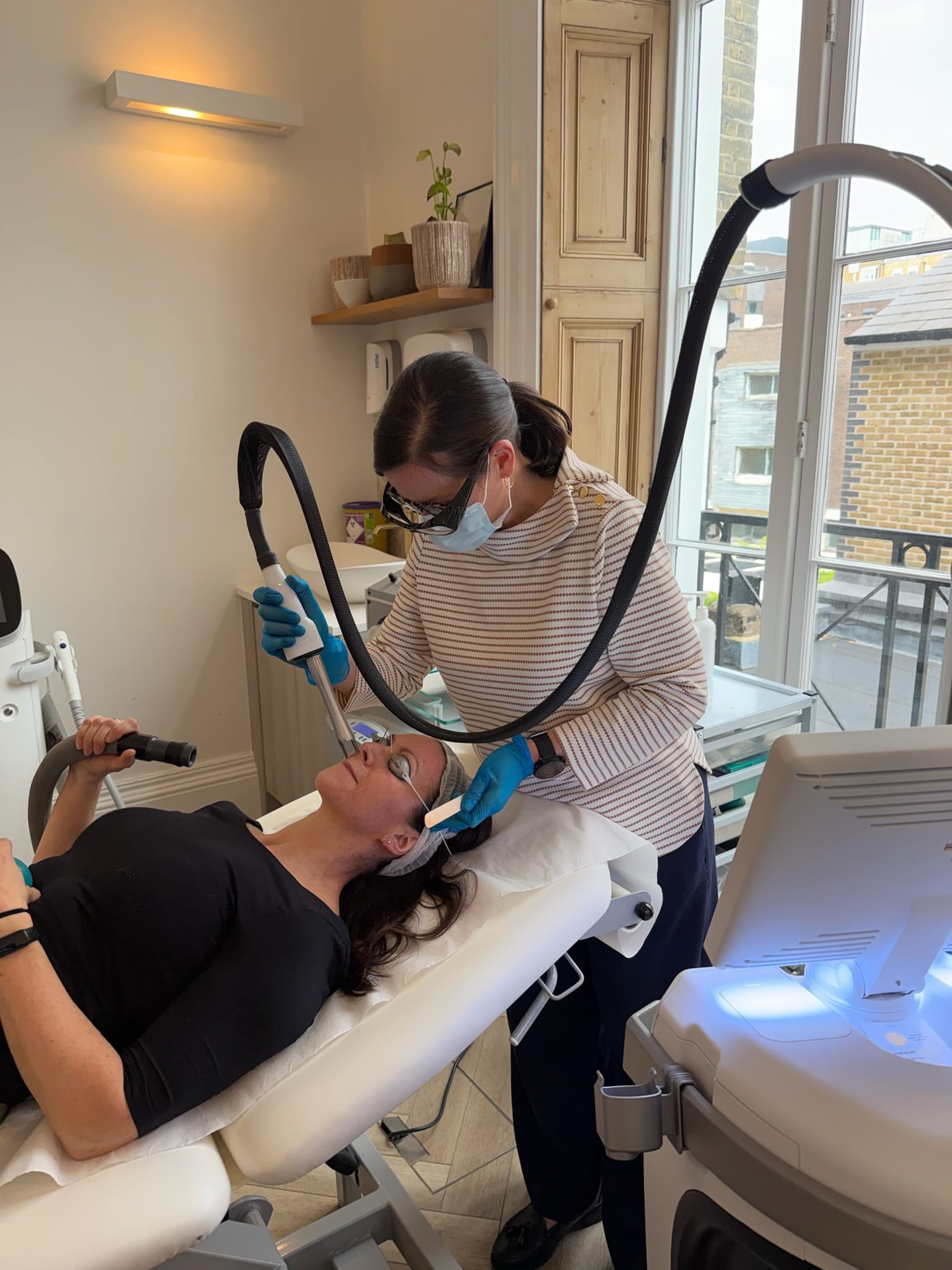
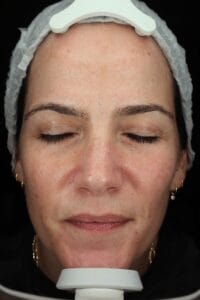
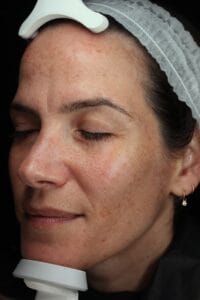
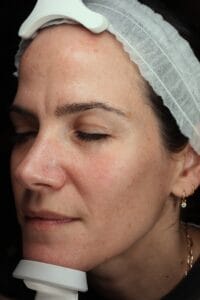
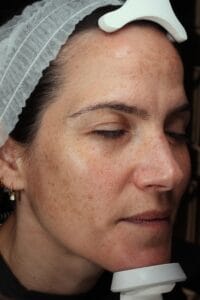
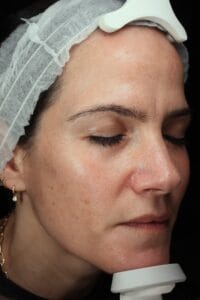
A 47-year-old woman came to Self London with persistent solar lentigines and uneven pigmentation across sun-exposed areas of her face. She had Fitzpatrick skin type III and underwent a single treatment with UltraClear, a 2910 nm fractional ablative laser, alongside medical management of her pigmentation. Her brown marks and overall pigmentation improved, without post-inflammatory hyperpigmentation, scarring or prolonged erythema in this individual case, and Dr Charlotte Keigwin and I subsequently documented the treatment, settings and clinical photography in a clinical white paper.
A before-and-after photograph could tell that story very simply: pigment before, laser treatment, less pigment afterwards. What it cannot show is why I chose that particular treatment, why I used the laser in that particular way, what else formed part of the plan, or how readily I would have changed course if the patient sitting in front of me had been slightly different.
Why this treatment suited this patient
Solar lentigines are the well-defined brown marks that accumulate on chronically sun-exposed skin. There is more than one legitimate way to treat them. A 2025 systematic review of 41 clinical trials involving more than 3,200 patients found useful results with several approaches, including intense pulsed light and different laser technologies, with differences in efficacy and adverse effects between treatments. There is therefore no evidence-based reason to assume that one particular machine must be the correct answer for every patient with sun spots.
There was also a more fundamental question to answer before deciding on a device. “Pigmentation” describes what something looks like; it does not tell me why it is brown. Solar lentigines, melasma and post-inflammatory hyperpigmentation may all be described by a patient as pigmentation while behaving quite differently when treated. There are also pigmented lesions that warrant medical assessment rather than cosmetic removal, so the diagnosis has to come before the laser.
In this patient, the documented problem was persistent solar lentigines and early melasma affecting sun-exposed facial skin. We chose UltraClear and deliberately used two different fractional passes rather than applying one uniform treatment across the face. The first treated the skin at a depth of 300 micrometres followed by a much more superficial 30-micrometre pass. No coagulation (or additional heat) was used in either pass and the surface area of skin treated was chosen carefully.
Those figures are more useful when translated into what we were trying to achieve. A very small proportion of the skin received deeper fractional treatment, while a much larger proportion received very superficial treatment directed towards the surface and pigment irregularity. We were not simply turning the laser “up”. Different parts of the procedure were being used at different depths for different purposes. This relied on understanding where in the skin the pigment cells were sitting and causing the observable clinical issue.
The laser was also only one part of the treatment plan. We applied topical tranexamic acid immediately afterwards and subsequently introduced hydroquinone 10% with kojic acid 5%; the patient had been using the latter for two weeks by the time the follow-up photographs were taken. I think that detail matters because before-and-after photography can make clinical treatment look much cleaner than it really is. It would be inaccurate to attribute every element of the final pigment improvement to UltraClear when pigment-suppressing medical treatment was being used around the procedure.
The outcome after one single session, however, was excellent, with a visible reduction in the solar lentigines and more even pigmentation. It remains a single Fitzpatrick III clinical case rather than evidence that these parameters will behave identically in every patient. This distinction does not diminish the result; it simply puts it in the proper context.
Results
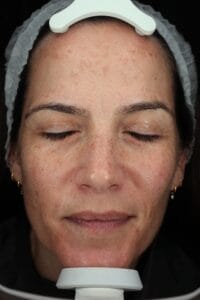
Before – Front
After – Front
Before – Left Side
After – Left Side
Before – Right Side
After – Right Side
Now change the patient
This is where I think the case becomes more useful than a conventional treatment showcase. Keep the brown pigmentation exactly the same but add significant acne scarring, and I am no longer treating only photodamage and pigment. I also need to understand the architecture underneath the surface.
Atrophic acne scars can include rolling, boxcar and ice-pick morphology, and that distinction matters because different scar types reflect different structural problems. Rolling scars may have fibrous tethering beneath the skin and sometimes require subcision; deeper focal scars may need focal treatment; broader textural scarring may respond to resurfacing. In a patient with mixed scarring, laser may be one part of the plan rather than the entire plan.
If our original patient had also had significant tethered rolling scars, I would not simply have taken the successful UltraClear settings and increased the intensity. I might want to release the tethering first, deal with deeper scars separately and then use fractional resurfacing within a staged programme. The solar lentigines have not changed, but the addition of a different structural problem has changed both what I need to treat and potentially the order in which I treat it.
Now keep the pigmentation identical but change the degree of ageing. If the patient also had coarse texture, considerably more advanced photodamage and deeply etched lines, the relatively pigment-focused treatment used in our documented case might improve her brown marks while leaving the feature that troubles her most largely untouched. Depending on the examination, anatomical area, acceptable downtime and degree of change required, I might consider deeper fractional treatment or more extensive Er:YAG resurfacing instead.
The decision changes again if significant facial redness and superficial vessels accompany the pigmentation and textural change. BBL HEROic may then have a useful role in addressing vascular and superficial pigment abnormalities, while resurfacing is reserved for the structural component. This does not mean that every face containing several problems needs several treatments. It means that asking one increasingly aggressive procedure to deal with several different biological targets is not always the most sensible way to approach them.
Skin type and previous behaviour after inflammation can alter the plan just as materially. If the same patient had a darker phototype and a history of persistent post-inflammatory hyperpigmentation, I would not automatically reproduce a protocol that behaved well in Fitzpatrick III skin. Treatment depth, fractional density, percentage coverage, number of passes, preparation and aftercare may all need to change, and in some patients I would choose another treatment entirely. Reviews of laser complications in Fitzpatrick IV–VI skin consistently emphasise the importance of experience, appropriate device selection and greater caution because pigmentary complications are a particular concern.
The most fundamental change occurs if the diagnosis itself changes. A patient may arrive describing brown patches as “sun damage”, but if the dominant problem is actually melasma I am dealing with a chronic, recurrent pigmentary disorder rather than straightforward solar lentigines. Photoprotection and medical pigment management may need to come first, energy-based treatment becomes much more selective, and there are patients in whom I would advise against ablative resurfacing altogether.
All of these patients could contact Self London using remarkably similar language: pigmentation, sun damage, ageing skin, perhaps a request for laser rejuvenation. One might ultimately have UltraClear, another Er:YAG, another BBL HEROic, another might require scar treatment before resurfacing, while another might leave with prescription pigment treatment rather than a laser appointment. The concern can sound almost identical while the appropriate treatment plan is not.
Why the same laser can mean a very different treatment
This is why comparing clinics simply by checking whether they own the same machine tells you less than it appears to. A laser platform gives the clinician a range of possible tissue effects; the brand name alone does not describe the treatment being delivered.
With fractional resurfacing, changing depth, density and percentage coverage alters where and how much tissue is treated. Number of passes, anatomical site and the amount of thermal effect can further change the balance between clinical effect, recovery and risk. Diagnosis, skin type, previous treatment and the way somebody’s skin responds to inflammation then influence how those variables should be used. Medications an individual takes could have an impact on wound healing and ability to generate appropriate inflammation after a resurfacing procedure. There are many variables one needs to consider.
Two people can therefore both say that they have had “UltraClear” and yet have undergone materially different procedures. Our own case illustrates this particularly well because the parameters are publicly available: 300 micrometres at 2% coverage followed by 30 micrometres at 30%. Copying those figures is easy but deciding whether they make sense for another patient’s diagnosis, scar pattern, anatomy, phototype and treatment goal is the harder part. Laser settings aren’t like following a cooking recipe.
This matters increasingly because patients are understandably becoming familiar with branded treatments before they reach the consulting room. UltraClear, HALO, BBL and other device names are marketed directly to consumers, and somebody may arrive having researched a particular procedure extensively. The difficulty is that choosing the treatment before somebody has examined the skin effectively asks the patient to make part of the clinical decision before the consultation has taken place.
Why this changes how we practise at Self London
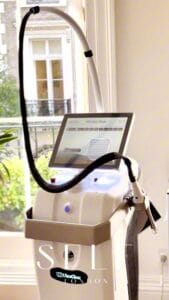
At Self London I work across several laser and light platforms, including UltraClear 2910 nm, Er:YAG resurfacing, HALO and BBL HEROic. There is overlap between them, but together they give us different ways of approaching superficial pigmentation, vascular change, mixed pigment and texture, and more significant structural photodamage.
The purpose of having that breadth is not to produce a bigger treatment menu or to persuade somebody to have several procedures when one will do. It is to have meaningful alternatives and combinations. Someone whose principal problem is superficial pigment and redness may not need ablative resurfacing at all, while a patient with more advanced structural change may require a different depth or method of resurfacing. If scar tethering is present, another procedure may need to come first; if the diagnosis is melasma or pigmentary risk is high, the laser plan may become substantially more conservative or disappear altogether.
Having both UltraClear and Er:YAG is useful precisely because I do not need to construct an argument that one resurfacing platform must be universally superior to the other. Likewise, BBL HEROic and HALO give me options where the treatment target is different. The value of having several technologies appears when the patient does not fit the treatment we might initially have expected to use.
I have worked clinically with lasers and energy-based devices for more than a decade alongside my practice as a Consultant Dermatologist, including pigment and vascular treatments, acne, fractional resurfacing and more extensive ablative work. Dermatology training and laser experience contribute different things. The first helps me establish what I am looking at, recognise disease that may resemble a straightforward cosmetic concern and use medical treatment when that is required; the second matters when deciding how a device should actually be used, at what depth and density, in which anatomical area and with what degree of acceptable risk.
This is also why new patients at Self London do not undergo laser treatment on the same day as their initial consultation. The appointment is used to examine the skin, establish the diagnosis, understand what the patient wants to change, review relevant medical and treatment history and decide whether the likely benefit of a procedure justifies its recovery and risk. As a consultant dermatologist-led, CQC-regulated clinic, we also have the option to prescribe, investigate or decline treatment when the problem in front of us requires something other than a laser.
What this case actually shows
The clinical photographs from this case show useful improvement in solar lentigines and melasma following one 2910 nm fractional treatment used as part of a broader pigment-management strategy. They are valuable because they represent real clinical work from Self London and because the treatment parameters have been documented, but I do not think the most useful conclusion is simply that UltraClear can improve sun-related pigmentation.
The more interesting lesson is how much decision-making sits between a patient saying “I want my sun damage treated” and a laser actually being fired. Change the scar architecture, the depth of ageing, the phototype, the tendency to pigment after inflammation or the underlying diagnosis and I may change the settings, the technology, the sequencing or the decision to use a laser at all.
For a patient comparing clinics for pigmentation, sun damage, acne scarring or facial rejuvenation, I would therefore look beyond whether both clinics advertise the same machine. I would want to know who is diagnosing the problem, how much experience they have with laser resurfacing, whether they have meaningful alternatives if the expected treatment is inappropriate and whether they can manage the skin medically as well as procedurally.
Our patient had UltraClear because UltraClear, used in this particular way and alongside appropriate pigment management, made sense for the skin in front of us. Another patient with superficially similar concerns might leave Self London with a recommendation for Er:YAG, BBL, HALO, combination treatments, prescription therapy or no laser at all. That ability to change the treatment when the patient changes is the reason Self London has been built around specialist assessment and access to more than one technology.
Further reading
Mahto A, Keigwin C. Targeted Laser Treatment of Solar Lentigines and Hyperpigmentation on Sun-Exposed Facial Areas Using the 2910 nm Fiber Laser: A Case Study Demonstrating Safety and Efficacy. Clinical White Paper. 2025.
Mardani G, Nasiri MJ, Namazi N, Farshchian M, Abdollahimajd F. Treatment of Solar Lentigines: A Systematic Review of Clinical Trials. Journal of Cosmetic Dermatology. 2025;24(4):e70133. doi:10.1111/jocd.70133.
Jacob CI, Dover JS, Kaminer MS. Acne scarring: a classification system and review of treatment options. Journal of the American Academy of Dermatology. 2001;45(1):109–117. doi:10.1067/mjd.2001.113451.
Soares I, Pereira Amaral I, Pupo Correia M, Travassos R, Filipe P. Complications of dermatologic lasers in high Fitzpatrick phototypes and management: an updated narrative review. Lasers in Medical Science. 2024;39(1):149. doi:10.1007/s10103-024-04100-4.
Gan C, Rodrigues M. An Update on New and Existing Treatments for the Management of Melasma. American Journal of Clinical Dermatology. 2024;25(5):717–733. doi:10.1007/s40257-024-00863-2.