TL;DR
- VISIA skin analysis helps identify concerns such as pigmentation, redness, pores, texture, wrinkles and UV damage.
- VISIA is an imaging and monitoring tool, not a diagnosis or treatment plan.
- The same VISIA finding can have different causes, so treatment must be tailored individually.
- Brown spots may require BBL, HALO, UltraClear, skincare or pigment control depending on whether the cause is sun damage, melasma or post-inflammatory pigmentation.
- Redness may respond to BBL, ClearSilk, vascular laser or rosacea-focused treatment.
- Pores and texture may need acne treatment, retinoids, resurfacing or collagen stimulation depending on the underlying issue.
- Wrinkles and fine lines often require a combination of resurfacing, tightening, skincare or injectables.
- VISIA is most valuable when used alongside expert clinical assessment and long-term treatment planning.
- At Self London, VISIA consultations are medically led and focused on creating personalised, staged treatment plans rather than selling a single device or procedure.
The best treatment for a VISIA finding depends on what that finding represents. Brown spots may be treated with BBL, HALO, UltraClear, prescription skincare, pigment control or photoprotection, depending on whether they are caused by sun damage, melasma or post-inflammatory pigmentation. Red areas may require BBL, ClearSilk, vascular laser, rosacea treatment or barrier repair. Pores and texture may respond to prescription retinoids, acne control, light-based treatment, resurfacing or collagen-stimulating treatments, depending on whether the underlying issue is oiliness, photodamage, acne scarring or ageing. Wrinkles may require resurfacing, skin tightening, regenerative treatment, botulinum toxin, skincare or a carefully sequenced combination. VISIA helps identify the pattern, but it does not replace diagnosis; it is best understood as an imaging and monitoring tool, not as a treatment plan in itself.
This distinction matters because one of the reasons skin treatments disappoint is that patients are often treated for what they can see, rather than for what is actually driving the visible change. A patient may say they have pigmentation when part of what they are noticing is redness. They may describe their skin as dull when the problem is texture, pores, early photodamage or dehydration. They may think they need resurfacing when the main issue is vascular change. They may ask for treatment of acne scarring, when a large part of what they are seeing is post-inflammatory redness or brown marks rather than true atrophic scarring. Objective skin imaging can bring structure to these conversations, not because it replaces clinical judgement, but because it allows the patient and clinician to examine the skin more closely before deciding which treatment, if any, is most appropriate.
For patients considering VISIA skin analysis in London, the value lies not simply in having a scan, but in having the findings interpreted within a clinic that can offer medically led treatment planning. At our Harley Street clinic, VISIA is used as part of a broader skin health consultation rather than as a standalone sales tool. In simple terms, VISIA can help show what is present in the skin, while the consultation determines what those findings mean, which concerns should be treated first, and whether the most appropriate route is laser, light-based treatment, medical skincare, acne control, collagen stimulation, pigmentation management or a staged combination.
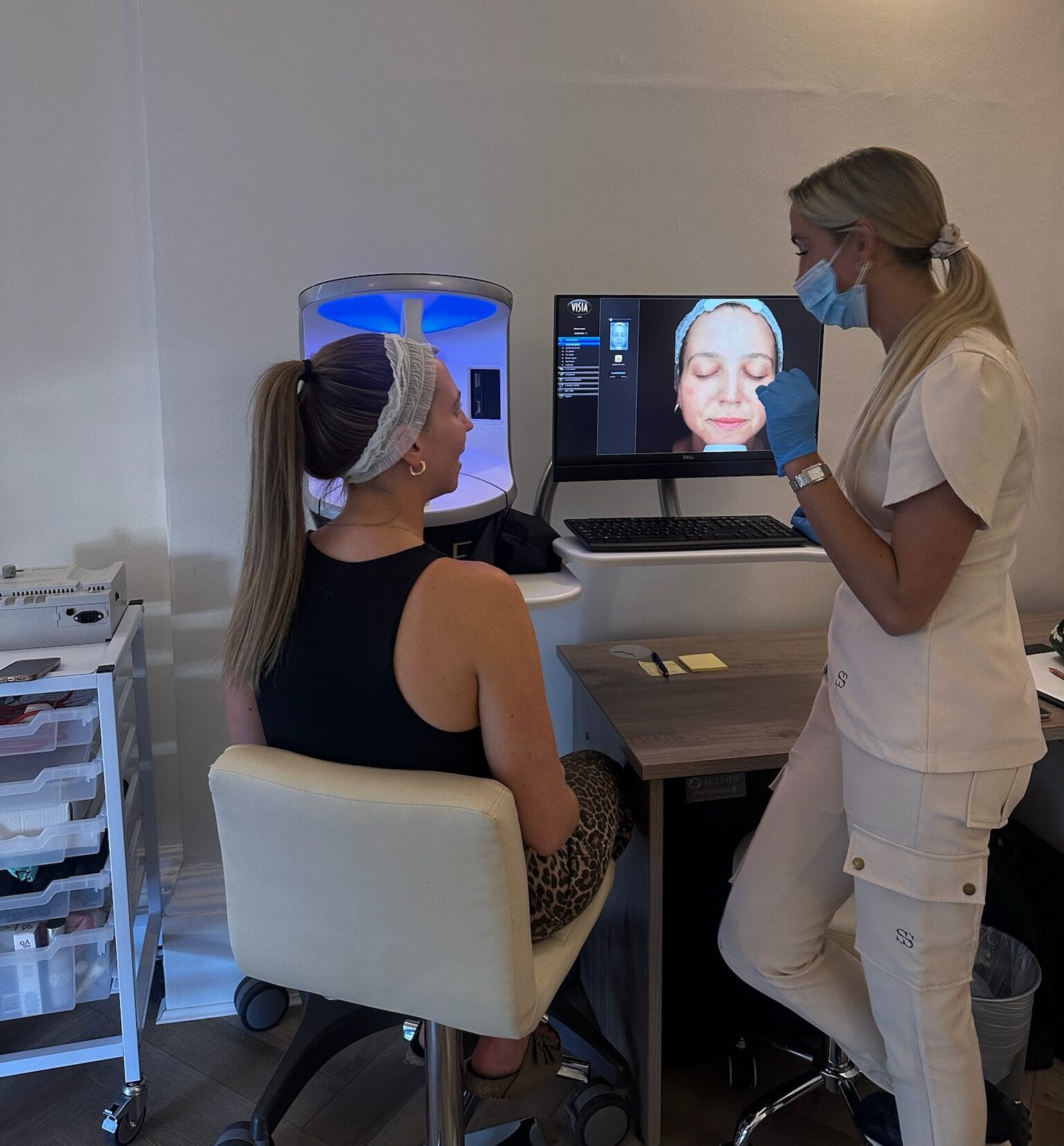
VISIA is a complexion analysis system that captures standardised facial images and assesses a number of visible and subsurface skin features, including spots, wrinkles, texture, pores, UV spots, brown spots, red areas and porphyrins. In practical terms, it can help document the features that contribute to how the skin looks at baseline, while also giving a reference point from which future progress can be monitored. At Self London, VISIA is not used as a way of frightening patients into treatment. It is used as part of a more thoughtful consultation, particularly for patients who want to understand their skin properly before investing in laser, light-based treatments, injectables, skincare or a longer-term maintenance plan.
At Self London, VISIA-led consultations are carried out by our laser therapists, Katie and Claudia, who work within consultant dermatologist-designed protocols. This means that the imaging is not interpreted in isolation, nor is it used simply to match a score to a treatment. It sits within a medically overseen pathway that considers whether the patient is best suited to laser, light-based treatment, acne treatment, skin tightening, prescription skincare, regenerative treatments or referral into a doctor-led treatment plan. The purpose is not to sell a treatment from a scan. It is to understand the skin, decide what matters most and build a plan that is safer, more precise and easier to measure over time.
What does VISIA skin analysis show?
VISIA can show brown spots, red areas, texture, pores, UV-related change, wrinkles and porphyrins, but it cannot, by itself, explain why those findings are present. A brown spot may be sun damage, melasma, post-inflammatory pigmentation or a combination of several pigmentary processes. Redness may be rosacea, post-acne erythema, irritation, barrier dysfunction or background vascular change. Texture may be acne scarring, enlarged pores, roughness, fine lines, congestion, surface dryness or early photodamage. A VISIA image can reveal the pattern, but the interpretation still requires clinical judgement.
This is why a VISIA skin analysis is most useful when it is not treated as a scorecard. The numbers and images may help patients see what is present, but the real value comes from deciding what those findings mean, which ones are driving the patient’s concern, which should be treated first and which may be better left alone. In a clinic setting, a high pore score, a red area finding or visible UV damage should not automatically lead to one particular device. It should lead to a proper discussion about cause, treatment options, risk, sequencing and realistic outcomes.
It is also important not to become overly fixated on a single VISIA number. Scores and percentiles can be useful, but they are not the whole story. They should be interpreted in the context of age, skin type, lighting-standardised imaging, clinical history, recent inflammation, sun exposure, skincare use and the patient’s own goals. At Self London, we are more interested in patterns, trends and treatment response over time than in turning one isolated score into a diagnosis. VISIA is most powerful when it helps us measure change and guide a plan, rather than when it is used to make patients feel anxious about a number on a screen.
What treatments work best for VISIA brown spots, pigmentation and sun damage?
One of the common reasons patients book a VISIA consultation is concern about pigmentation. They may notice brown marks, uneven tone, freckles, sun spots or a general dullness that makes the skin look less clear. VISIA can help identify visible brown spots and UV-related change, including pigmentation that may be more extensive than the patient realises. This can be particularly helpful for patients who feel their skin has aged suddenly, because pigmentation often has a disproportionate effect on how old or tired the skin appears.
The most important step is to decide what type of pigmentation is present. Brown spots may represent solar lentigines, post-inflammatory hyperpigmentation, melasma, freckles or a combination of several processes. A patient with discrete sun spots on fair skin is not the same as a patient with hormonally influenced melasma on South Asian skin. A patient with brown marks after acne is not the same as someone with chronic photodamage after years of ultraviolet exposure. The treatment has to follow the diagnosis.
For straightforward sun damage and solar lentigines, BBL is often one of the most useful first-line treatments, particularly when pigment is superficial and there is also background redness or vascular change. BBL HEROic or BBL HERO can improve pigmentary and vascular components within the same treatment plan, which is valuable because many patients with sun damage do not have pigment alone. HALO may be considered when pigmentation sits alongside pores, fine lines and textural photodamage, because it can combine resurfacing and collagen stimulation with improvement in overall skin quality. UltraClear may be useful when pigmentation is part of a broader rejuvenation or resurfacing plan, particularly where the skin also shows texture, fine lines, scars or early collagen change. ClearSilk may be appropriate where the aim is more subtle maintenance, redness reduction or no-downtime refinement.
For melasma, the hierarchy is different. Melasma is a chronic, relapsing pigmentary disorder influenced by ultraviolet light, visible light, heat, hormones and inflammation. It is not simply a collection of brown marks waiting to be removed. In many patients, the first step is not laser at all, but pigment stabilisation with careful skincare, prescription topical treatment, strict photoprotection and avoidance of triggers. Oral tranexamic acid may be considered in selected patients where appropriate, and energy-based treatments must be approached cautiously. VISIA may help document the distribution of pigment, but clinical history and diagnosis are essential because treating melasma like simple sun damage can make it worse.
At Self London, this distinction is central to pigmentation treatment. VISIA can show the pattern, but the clinician must decide whether the safest route is BBL, HALO, UltraClear, ClearSilk, prescription skincare, tranexamic acid, Dermamelan, laser-assisted drug delivery or a staged plan that begins with pigment control before any energy-based treatment is considered. The best treatment for pigmentation is not always the strongest device. It is the treatment that improves pigment without provoking more pigment.
What treatments work best for VISIA red areas, flushing and rosacea-prone skin?
VISIA red areas may reflect vascular change, inflammation, rosacea, post-acne erythema, irritation or barrier dysfunction. This is one of the most useful parts of objective imaging because patients often describe redness and pigmentation together as “uneven skin tone”, yet the treatments are different. Brown pigment and red vascular change may overlap visually, but they do not respond to the same treatment in the same way.
For patients with background redness, flushing, visible vessels or rosacea-prone skin, BBL, ClearSilk, vascular laser and carefully selected skincare are often more relevant than resurfacing. BBL can be useful when redness sits alongside pigment and sun damage. ClearSilk may be helpful for more subtle diffuse redness, mild vascular instability and patients who want minimal downtime. Vascular lasers may be needed when telangiectasia or more defined vessels are prominent. In patients with rosacea, treatment may also require topical or oral medical therapy, trigger management and barrier repair.
VISIA can help prevent a common sequencing error. A patient may think they need a resurfacing laser because the skin looks uneven, when the dominant issue is vascular redness. Resurfacing may improve texture, but it will not necessarily be the best treatment for redness and, in some cases, may aggravate inflammation if used inappropriately. Similarly, a patient with acne scarring may be distressed by the appearance of red marks, but those marks may represent post-inflammatory erythema rather than permanent scarring. Treating erythema with BBL, ClearSilk or vascular treatment may make the skin look significantly better before deeper scar work is even considered.
At Self London, redness is not treated as a purely cosmetic colour issue. It may reflect rosacea, acne activity, barrier dysfunction, sun damage, vascular reactivity or inflammatory skin disease. VISIA helps document the red component, but the treatment plan depends on what is causing it. This is why a VISIA-led consultation can be valuable: it separates the different contributors to “uneven tone” so that the treatment is not chosen blindly.
What treatments work best for VISIA pores and skin texture?
Pores are one of the most common concerns patients raise, and one of the most misunderstood. VISIA can quantify pores and texture, but the meaning of that information depends on the patient. Pores may appear more prominent because of oiliness, sebaceous activity, acne, skin laxity, photodamage, collagen loss or shadowing from uneven texture. In younger patients, pores may be driven by sebum and acne tendency. In older patients, they may appear worse because collagen support around the follicular openings has reduced. In acne-scarred skin, patients may call everything “pores”, when some of what they are seeing is actually shallow scarring.
The treatment hierarchy depends on the driver. If pores are associated with acne, congestion or oiliness, prescription skincare, retinoids where appropriate, acne control, AviClear, BBL Forever Clear or carefully selected peels may be more relevant than resurfacing at the outset. If pores are part of broader photodamage and surface roughness, BBL, ClearSilk, HALO or UltraClear may be considered. If the problem is collagen loss and textural ageing, resurfacing and collagen-stimulating treatments become more relevant. If the patient has true acne scarring, then scar mapping becomes more important than pore scoring.
UltraClear can be particularly useful when pores and texture overlap with rejuvenation or acne scarring, because the treatment can be adjusted from lighter resurfacing to more meaningful textural remodelling. HALO can also be very effective in patients with photodamage, pores and early textural change, particularly when the aim is an overall refinement of the skin surface. BBL and ClearSilk may improve the appearance of pores indirectly by improving redness, pigment, inflammation and overall skin quality. Prescription retinoids remain important for many patients because they improve epidermal turnover, acne tendency and long-term skin texture.
The key point is that pores are not simply holes to be closed. They are part of the skin’s anatomy, and their appearance depends on oil production, collagen support, surface texture and light reflection. VISIA can help track pore appearance over time, but treatment has to address why they are visible in the first place.
What treatments work best for VISIA UV spots and hidden sun damage?
One of the useful features of VISIA is its ability to show UV spots and underlying photodamage. These areas may not be fully visible to the naked eye, but they can indicate cumulative sun exposure and pigmentary change beneath the surface. For many patients, this is a turning point in how they think about their skin. They may have been focused on lines or pores, only to realise that sun damage is a major contributor to the way their skin is ageing.
The treatment of photodamage usually requires both correction and prevention. Correction may involve BBL, HALO, UltraClear, ClearSilk, topical retinoids, antioxidant skincare, pigment-regulating ingredients or, in selected patients, more intensive resurfacing. Prevention means daily broad-spectrum sunscreen, visible light protection where appropriate, behavioural changes around sun exposure and long-term maintenance. Without prevention, treatment becomes a cycle of chasing damage that continues to accumulate.
BBL is particularly useful for photodamage because it can address pigment and vascular change, and it is often used as part of long-term skin maintenance. HALO may be useful when UV-related pigment sits alongside fine lines, pores and textural roughness. UltraClear may be used when photodamage requires resurfacing, collagen stimulation and more visible rejuvenation. ClearSilk may be appropriate for lighter maintenance, subtle redness and no-downtime refinement. The right choice depends on the extent of the damage, the skin type, the patient’s tolerance for downtime and whether there is melasma or post-inflammatory pigmentation risk.
At Self London, we do not treat sun damage only as an aesthetic issue. Cumulative ultraviolet exposure is also relevant to skin health, including actinic damage and non-melanoma skin cancer risk. A skin-quality consultation therefore has to consider both appearance and prevention. VISIA can be a useful educational tool because it makes invisible damage more tangible, but the value comes from using that information to build a long-term plan.
What treatments work best for VISIA wrinkles and fine lines?
VISIA can assess wrinkles, but wrinkle treatment is rarely just a matter of resurfacing the surface. Fine lines may reflect dehydration, photodamage, collagen loss, repetitive movement, skin laxity or deeper structural ageing. A patient may see lines around the eyes and assume they need laser, but the best treatment may involve resurfacing, Sofwave, polynucleotides, botulinum toxin, skincare or a combination. A patient with etched lines around the mouth may need a different plan from someone with early crepiness under the eyes.
The under-eye area is a good example of why interpretation matters. Fine lines around the eyes may reflect thin skin, collagen loss, movement from smiling or squinting, dehydration, photodamage, periocular laxity, volume change or background redness and pigmentation that make the area look more tired. A wrinkle score alone cannot separate these causes. If the dominant issue is movement, carefully placed botulinum toxin may be appropriate. If the issue is skin quality, polynucleotides, resurfacing or regenerative treatment may be considered. If there is laxity or softening around the brow and upper cheek, Sofwave may form part of the plan. If there is pigmentation, redness or sun damage around the broader face, BBL, ClearSilk or pigment-focused treatment may be needed before or alongside periocular work.
HALO can be useful when fine lines are part of a wider pattern of photodamage, pores and surface dullness. UltraClear can be used when lines sit alongside texture, scars or more significant resurfacing needs, and it has an important role in rejuvenation because treatment intensity can be adapted. Sofwave may be considered where laxity and collagen decline are contributing to folds, jowling or softening of the lower face and neck. Polynucleotides may be used around delicate areas such as the eyes, or in patients where skin quality and regenerative support are priorities. Prescription skincare, particularly retinoids where tolerated, remains one of the foundations of long-term wrinkle prevention and skin maintenance.
This is where VISIA can be helpful, but also where it must be interpreted carefully. A wrinkle score does not tell the whole story. It cannot tell whether the patient needs resurfacing, tightening, injectable relaxation, regenerative treatment or skincare. It can help document the visible line pattern, but treatment selection requires assessment of skin quality, anatomy, movement and ageing pattern.
What treatments work best for VISIA porphyrins, congestion and acne tendency?
VISIA can detect porphyrins, which are associated with Cutibacterium acnes activity and can be relevant in patients with acne, congestion and oiliness. This can be useful when patients present with pores, breakouts, blackheads or texture but are not sure whether they have active acne, residual marks or simply oily skin. As with every VISIA feature, the finding has to be interpreted in context.
Porphyrins are a clue, not a complete acne assessment. They may suggest bacterial activity and a sebaceous environment, but they do not alone determine acne severity, hormonal contribution, scarring risk or the correct treatment. A patient with porphyrins and congestion may need a different plan from a patient with inflammatory acne, nodules, post-inflammatory pigmentation or early scarring. Clinical examination, history, distribution, menstrual pattern, medication tolerance and previous treatment response all matter.
If acne is active, the priority is acne control. This may involve prescription skincare, oral medication where appropriate, hormonal evaluation in selected patients, BBL Forever Clear, AviClear or a combination of treatments. At Self London, AviClear is particularly relevant for patients who want a non-drug option for acne, including those who wish to avoid isotretinoin, antibiotics or hormonal treatment, although suitability has to be assessed. BBL Forever Clear may be helpful for acne-prone skin, particularly when inflammation and redness are present. Prescription retinoids, benzoyl peroxide, azelaic acid and other medical treatments may still be central, depending on the patient.
It is important to treat active acne before treating acne scars. This is one of the most common sequencing errors in cosmetic dermatology. If the acne is still active, resurfacing the scars may be premature because new scars can continue to form. VISIA can help document acne-related features and redness, but the treatment plan must decide whether the patient is in the acne-control phase, the pigmentation phase, the redness phase or the scar-remodelling phase. Trying to treat all of these at once with one device is rarely the most intelligent approach.
What treatments work best for VISIA texture, acne scars and surface irregularity?
Texture is one of the broadest categories VISIA detects, and one of the easiest to misinterpret. Patients often use the word texture to describe pores, acne scars, bumps, roughness, fine lines, congestion, enlarged follicles, crepiness or even dryness. The role of the consultation is to clarify what the texture actually represents.
For simple roughness and early photodamage, BBL, HALO, UltraClear, ClearSilk, prescription retinoids and skin barrier optimisation may be enough. For acne scarring, the plan becomes more complex. True atrophic acne scars require scar assessment, because ice-pick, boxcar, rolling and tethered scars respond differently. Some patients may need subcision, TCA CROSS, UltraClear, fully ablative Er resurfacing, fractional resurfacing, polynucleotides or vascular treatment. Others may need acne control before any scar work begins.
UltraClear has an important role where texture overlaps with acne scarring, photodamage and rejuvenation, because it can be used across a range of treatment intensities. HALO may be useful where texture is milder and sits within a broader photorejuvenation picture. BBL and ClearSilk may help when the textural concern is amplified by redness or pigment. Sofwave may be relevant when texture is being worsened by laxity and collagen loss rather than surface damage alone.
This is why a VISIA texture score should never be treated as a prescription. It is a clue, not a diagnosis. The best treatment depends on whether the texture is epidermal, dermal, inflammatory, vascular, acne-related, scar-related or ageing-related.
What if VISIA detects more than one concern?
In real clinical practice, patients rarely have only one concern, and this is one of the reasons VISIA can be useful when it is interpreted properly. A patient may attend because they are bothered by fine lines around the eyes, but the imaging may also show background redness, sun spots, enlarged pores and early textural change. Another patient may believe their main issue is pigmentation, but the consultation may reveal that redness, post-inflammatory marks and surface irregularity are all contributing to the unevenness they see in the mirror. Skin quality is rarely a single measurement. It is the combined effect of pigment, redness, texture, pores, collagen loss, hydration, barrier function, sebaceous activity and the way light reflects from the skin.
This is why treatment planning should not simply involve matching one VISIA category to one device. Fine lines around the eyes, redness and sun spots may all require different interventions. The redness may respond best to BBL, vascular treatment or ClearSilk. The sun spots may need BBL, HALO, UltraClear, pigment-regulating skincare or careful photoprotection. The fine lines around the eyes may require a combination of collagen stimulation, resurfacing, polynucleotides, Sofwave or carefully selected injectable treatment, depending on whether the issue is skin quality, movement, laxity or photodamage. Treating only one component may produce some improvement, but it may not address the full reason the skin looks tired, uneven or older than the patient feels.
The skill lies in deciding what to treat first. In some patients, redness should be treated before resurfacing because inflammation is making the skin look more uneven. In others, pigmentation needs to be stabilised before any energy-based procedure is considered. A patient with active acne and early scarring may need acne control before scar treatment. A patient with fine lines, laxity and photodamage may need a plan that combines Sofwave for structural support with BBL or laser resurfacing for surface quality. A patient with melasma, redness and texture may need a cautious staged approach rather than an aggressive attempt to correct everything at once.
This is also where a clinic with multiple technologies has an advantage, provided those technologies are used intelligently. The value is not in offering more treatments, but in being able to choose the correct sequence. VISIA may show several findings, but the clinician still has to decide which finding matters most, which treatment is safest, which concern is driving the patient’s dissatisfaction and which interventions will complement rather than conflict with one another. The aim is not to chase every score on the screen, but to build a coherent plan.
This often means explaining to patients that their result may come from a sequence rather than a single treatment. For example, a patient with fine lines around the eyes, redness and sun spots may begin with BBL or ClearSilk to reduce redness and pigmentary noise, then move to UltraClear, HALO or another resurfacing approach for texture and collagen stimulation, with Sofwave or polynucleotides considered if laxity or delicate periocular skin quality is part of the picture. Another patient may need skincare and pigment control first, because treating too aggressively too early could worsen pigmentation. This is where VISIA becomes most valuable: not as a list of defects, but as a way of designing a more intelligent treatment pathway.
Do you need VISIA before laser or skin treatment?
Not every patient needs VISIA imaging before every skin treatment, and it should not be presented as an essential step for every concern. However, for patients investing in laser, light-based treatment, acne scar treatment, pigmentation treatment, redness treatment or long-term skin health, VISIA can provide a useful objective baseline. It helps document what is present before treatment begins, allows progress to be monitored more carefully, and can make the reasoning behind a treatment plan clearer.
This is particularly valuable when the patient has more than one concern, when the problem is difficult to describe, or when previous treatments have not delivered the expected result. A patient who thinks they need resurfacing may actually need vascular treatment first. A patient who thinks they have pigmentation may have a mixture of brown spots, redness and melasma. A patient who is focused on pores may have acne, oiliness, texture and early collagen loss. VISIA does not solve these problems by itself, but it can help reveal the pattern so that the consultation becomes more accurate.
VISIA is most useful when it becomes part of a longer-term strategy. It can help us document baseline pigmentation, redness, pores, texture and UV damage before BBL, ClearSilk, UltraClear, HALO, Sofwave, AviClear or skincare programmes. It can also help patients understand why a treatment plan may need to be staged, why one concern should be treated before another, or why the safest approach may initially be skincare, pigment control or acne treatment rather than laser.
Why VISIA does not replace clinical judgement
The greatest value of VISIA is that it makes skin changes visible and measurable. It allows the patient and clinician to look at the skin more objectively, identify patterns, document baseline features and track improvement over time. This is particularly helpful in a clinic like Self London, where many patients are not seeking a single cosmetic intervention, but a long-term skin health strategy.
However, VISIA is not the treatment plan. It does not decide whether a patient needs BBL, HALO, UltraClear, ClearSilk, Sofwave, AviClear, polynucleotides, prescription skincare, acne control, pigment stabilisation, vascular treatment or resurfacing. It cannot determine whether melasma is active, whether acne is hormonally driven, whether redness is rosacea, whether texture is scarring, or whether lines reflect laxity rather than surface ageing. Those decisions still require medical training, clinical experience and careful assessment.
This is why Self London uses VISIA as part of an ecosystem rather than as a standalone consultation gimmick. The imaging helps identify what is present. The clinician decides what matters, what should be treated first, what should be left alone, and what can realistically improve. In some patients, the VISIA findings lead to a laser plan. In others, they lead to skincare, acne control, pigment stabilisation, barrier repair, or a decision to delay treatment until the skin is safer to treat.
Which treatments work best for VISIA findings?
There is no single best treatment for a VISIA finding, because each category can have more than one cause. Brown spots may require pigment treatment, prescription skincare, strict photoprotection, light-based treatment or resurfacing, depending on whether the problem is sun damage, melasma or post-inflammatory pigmentation. Red areas may require vascular treatment, barrier repair, rosacea management or light-based treatment, depending on whether the redness is vascular, inflammatory or irritation-driven. Pores may require acne control, retinoids, collagen stimulation, resurfacing or light-based maintenance, depending on whether the cause is oiliness, photodamage, scarring or ageing. Wrinkles may require resurfacing, tightening, regenerative treatment, injectable relaxation, skincare or a combination, depending on whether the line is surface-related, movement-related or laxity-related. Texture may require anything from topical retinoids to fractional resurfacing, fully ablative resurfacing, subcision or scar-specific treatment, depending on what the texture actually represents.
The real benefit of VISIA is therefore not that it tells patients what treatment to have, but that it helps organise the conversation. It allows the patient to see the different components of skin quality and understand why a clinic may recommend vascular treatment before resurfacing, acne control before scar treatment, pigment stabilisation before energy-based procedures, or collagen stimulation before surface refinement. It makes the plan more transparent.
At Self London, the best treatment for a VISIA finding is the treatment that matches the diagnosis, not the one that sounds most impressive. Sometimes that means BBL for pigment and redness. Sometimes it means UltraClear for texture, rejuvenation and scarring. Sometimes it means HALO for photodamage and global refinement. Sometimes it means ClearSilk for redness and subtle skin quality. Sometimes it means Sofwave for collagen stimulation and laxity. Sometimes it means AviClear for active acne before any resurfacing is considered. Sometimes it means prescription skincare and waiting.
That is the point of a VISIA-led consultation. It is not to generate a score and sell a device. It is to understand the skin properly, choose treatments in the correct order and create a plan that can be measured over time. For patients who are serious about skin quality, this approach is often far more useful than choosing a treatment based on a trend, a photograph or a friend’s result.
If you are unsure whether your skin needs laser, light-based treatment, prescription skincare, acne control, collagen stimulation or simply a more accurate diagnosis, a VISIA-led consultation at Self London can help establish the pattern first. From there, the aim is not to sell a treatment from a scan, but to build a plan that is safer, more precise and easier to measure over time.