
How do I choose a safe laser clinic in the UK?
A safe laser clinic always starts with a diagnosis. The practitioner should be able to identify precisely what is happening in your skin, what layer is affected, and whether the problem is vascular, pigmentary, inflammatory, textural or structural. This matters because different lasers target different chromophores and depths. Choosing a device before making a diagnosis is like prescribing antibiotics without knowing the infection. In a medical clinic, the diagnostic process is the anchor for everything that follows.
A safe clinic also places the laser within a wider framework of governance. This includes medical oversight, clear ownership of clinical responsibility, the ability to prescribe medication, and policies for managing complications. The service should operate within a regulated structure, ideally with Care Quality Commission registration. CQC oversight signals that the practice is inspected for infection control, consent, documentation, staffing and safety. Although not mandatory for all clinics, in the context of cosmetic dermatology, it reflects a clinic taking its responsibilities seriously.
Beyond diagnosis and governance is the environment itself. Laser should be carried out in a clinical treatment room with adequate ventilation, eye protection, sterile consumables, safe electrical layouts and appropriate equipment. The room must be equipped for procedures that generate heat, airborne particles and potential wound exposure. If a laser is being used in a space designed only for beauty treatments, the risk control is fundamentally different.
A safe clinic will also be transparent when you ask how frequently they treat your condition, what devices they use for it, and how they decide when laser is appropriate. The tone of their answer matters. People who understand laser speak about indications, wavelengths, fluence, pulse duration, tissue targets and recovery. People who do not understand laser speak mainly about brand names.
Who should perform a laser consultation?
The person performing your laser consultation should be trained to diagnose skin conditions, not simply to operate machinery. Laser is not a “treatment menu” choice; it is a medical intervention with a risk profile shaped by underlying disease, medications, skin type, recent sun exposure and personal history. Acne scarring, melasma, rosacea, dermatitis, post-inflammatory pigmentation and early skin cancers are frequently misinterpreted in non-medical settings. Misdiagnosis is one of the most common causes of poor outcomes. No laser, however advanced, can compensate for an incorrect diagnosis.
A consultant dermatologist is best placed for complex cases, recurrent pigmentation, darker skin types, scarring, vascular instability and any situation where diagnosis is uncertain. Senior laser practitioners can be excellent when working under medical oversight with clear protocols. What matters is that the diagnostic responsibility sits with someone trained to recognise disease and manage complications. If something unexpected occurs after treatment, such as infection, inflammation or pigment change, you need immediate access to a prescriber who understands what to do. A clinic that cannot prescribe is unable to provide complete care.
Experience with your skin type also matters. Fitzpatrick IV to VI skin requires more conservative protocols and careful selection of devices because the risk of post-inflammatory hyperpigmentation and textural alteration is higher. Your practitioner should be able to explain how they adapt wavelengths, pulse durations and passes for darker skin. If they cannot, you are not in the right clinic.
Is the clinic medically regulated, and does CQC registration matter?
CQC registration is not mandatory for every laser provider, but it remains a meaningful indicator of quality. A CQC-registered medical clinic has undergone inspection to evaluate governance, cleanliness, staff training, safety procedures, documentation, safeguarding and leadership. The standards required for registration align with the expectations of medical practice rather than the looser environment found in unregulated aesthetic spaces.
Patients sometimes underestimate the significance of governance until something goes wrong. In a CQC-registered clinic, protocols exist for infection control, adverse events and follow-up. There is accountability, a named registered manager, and a requirement to demonstrate learning from incidents. CQC oversight also supports a culture of transparency. When a clinic is willing to subject itself to medical scrutiny, it signals seriousness about patient safety.
The absence of CQC registration does not automatically imply low standards, but its presence is reassuring when lasers capable of significant energy delivery are used. If a clinic is not CQC-registered, ask how they ensure quality and safety, who is clinically responsible for the service, how they manage complications and whether they work with a laser protection advisor.
What is a laser protection advisor, and why does it matter?
A laser protection advisor, often shortened to LPA, is an independent specialist responsible for ensuring that a clinic operates lasers under safe conditions. Their role includes reviewing equipment, writing local rules, checking the suitability of treatment rooms, ensuring eyewear matches wavelengths used, advising on plume extraction and confirming that staff training is appropriate.
Clinics that work with an LPA tend to have stronger safety systems and clearer structure. The presence of an LPA signals that the clinic adheres to nationally recognised safety standards, rather than relying solely on internal judgement. If a clinic does not use an LPA, it is appropriate to ask what safety framework they follow, how they manage risk assessments and how they keep staff competent.
What is laser plume, and does it pose a risk?
Laser plume refers to the airborne particles produced when energy interacts with tissue. With ablative or high-energy resurfacing lasers, microscopic fragments of skin, viral particles and potentially viable cells become suspended in the air. These require proper extraction and ventilation because they can be inhaled or settle on surfaces. Research has shown that plume from some skin treatments can contain viral DNA, including HPV, which is why medical environments follow stringent protocols for plume management.
If a clinic does not use plume extraction during resurfacing or dismisses the question altogether, it indicates a lack of understanding of the science behind lasers and the safety obligations that accompany it. Proper plume evacuation, PPE, air filtration and clinical cleanliness are essential. It is not acceptable for resurfacing to take place in a room without these measures. The public rarely knows to ask this question, which is why it is so important to include it here.
Is laser safe for dark skin?
Laser can be safe and effective in darker skin types when used correctly. The challenge is that melanin absorbs heat, and heat is the mechanism through which laser energy reaches its target. In lighter skin, lasers can be used more aggressively because the contrast between the target chromophore and background melanin is greater. In darker skin, too much energy or the wrong wavelength can cause post-inflammatory hyperpigmentation, hypopigmentation or, rarely, scarring.
The practitioner should be able to explain exactly how they adapt protocols for darker skin, which devices they avoid and why, and what steps they take to minimise risk. They should describe how they prevent excessive heat build-up, how they choose longer wavelengths to bypass epidermal melanin, and how they adjust fluence and pulse durations. These details matter. If a practitioner cannot articulate them, they may not be experienced in treating darker skin.
Your risk is shaped not only by skin type but by recent sun exposure, underlying conditions, hormonal influences and the specific diagnosis. Melasma, for instance, is notoriously sensitive to heat. A clinic that treats melasma aggressively with the wrong device risks worsening the condition. Darker skin can do exceptionally well with laser when it is treated by people who understand the physics.
Is IPL the same as laser?
IPL is not a laser. A laser emits a single wavelength of light that targets a specific chromophore, such as haemoglobin, melanin or water. IPL emits a broad spectrum of light filtered to approximate certain targets. This makes IPL less selective and more dependent on practitioner experience. IPL can be highly effective for superficial pigment and redness when used appropriately, but its safety margin is narrower in darker skin and in certain diagnoses.
When a clinic proposes IPL, they should be clear about why it is the correct choice for you. They should acknowledge its limitations and explain why they are selecting it over a laser. If IPL is described as a catch-all tool that solves everything, or if it is used indiscriminately on darker skin, it suggests the practitioner may not have access to a full range of devices or may not understand the nuances of light-based therapy.
What devices does the clinic use for different conditions, and why?
The device recommended should match your diagnosis. A vascular laser treats redness by targeting blood vessels. A pigment laser or broadband device targets melanin. A fractional resurfacing laser creates controlled microinjury to remodel texture and scarring. A hybrid fractional system blends wavelengths to treat multiple layers at once. An ablative device vaporises columns of skin tissue and is used for deeper scarring or more advanced photoageing.
This variety is not cosmetic but functional. If a clinic offers only one device, it may steer every concern toward it. This is rarely appropriate. Acne scarring, for example, should not be treated with the same device used for redness. Pigmentation should not be treated with the same settings used for deep resurfacing. A clinic with several complementary devices can select the right one. A clinic with a single device often makes the problem fit the tool.
When you ask why a specific device has been chosen, you should hear a discussion of wavelength, depth, chromophore, downtime and risk. You should hear reference to your diagnosis and your skin type. These explanations reflect genuine understanding.
How many laser sessions will I need for meaningful results?
Different skin concerns respond at different speeds. Vascular issues such as discrete broken capillaries may respond after a single session, although most people require two or three sessions spaced several weeks apart. Diffuse redness related to rosacea is more complex and may need staged treatment because the condition is chronic and influenced by triggers beyond the skin.
Pigmentation behaves differently again. Sun spots may clear after one treatment, but post-inflammatory pigmentation often requires several. Melasma, which is hormonally driven, typically requires a combined approach of pigment suppression, sun protection and cautious, conservative laser or light-based work only in selected cases.
Acne scarring remodels slowly. Even with a fractional or ablative laser, collagen takes months to reorganise, and the degree of improvement is dependent on both depth and consistency of treatment. Most people need a sequence of sessions, often three or more, adjusted for intensity depending on downtime tolerance and skin type. The pace of your life matters here. Aggressive resurfacing might produce dramatic results in a single session, but if you cannot tolerate the downtime or if your skin type increases the risk of complications, a safer staged approach may be more appropriate.
A good clinic explains this honestly. They do not promise absolute correction of scars, nor do they suggest that a complex condition will resolve in a single sitting. They also avoid pushing you into purchasing a fixed package before they understand how your skin responds. A responsible practitioner plans but adapts continuously.
How long is downtime after laser, and what will recovery involve?
Downtime varies substantially depending on the device, the settings used, the number of passes, the density of treatment and your skin’s sensitivity. Non-ablative treatments may leave the skin warm and flushed for several hours, sometimes with mild swelling the following day. Deeper fractional resurfacing can produce pinpoint bleeding, significant redness, swelling and several days of visible texture.
A clinic should provide clear, unhurried information about what the first seventy-two hours will look like and how long you can expect redness to persist. You should know how to cleanse, how often to moisturise, what to avoid and when to resume exercise. You should also be told which products to pause, such as retinoids, acids and some antioxidants. Aftercare products should be chosen deliberately, not as an afterthought.
The quality of aftercare matters as much as the treatment. Poor aftercare can increase the risk of infection, prolong inflammation and worsen pigment problems. A clinic familiar with energy-based devices will outline a structured plan. They will explain when to reintroduce active ingredients and how to protect the barrier as it recovers. They will also provide a point of contact in case anything feels unusual.
Downtime planning should respect your lifestyle. If you exercise frequently, travel often or work in a public-facing role, the clinic should factor this into treatment timing. A safe plan accounts for your real life, not a theoretical ideal.
Does laser hurt, and how is pain managed?
Laser sensation varies depending on wavelength, depth and energy. Vascular lasers can sting sharply. Broadband light feels like the snap of heat against the skin. Fractional resurfacing creates a prickling heat that intensifies with density. Ablative resurfacing can be significantly uncomfortable if performed without anaesthesia.
A clinic should prepare you for this honestly. They should explain what level of sensation to expect and what will be available to help you manage it. Many non-ablative treatments can be performed with a topical anaesthetic or with cooling alone. Ablative or deeper fractional treatments may require topical anaesthetic and, in some cases, local anaesthetic injections to improve comfort in specific areas. Some practices use cooling devices to manage heat build-up during treatment.
Pain management is not cosmetic. It allows the practitioner to deliver energy accurately and safely without having to compromise intensity simply because you are uncomfortable. A clinic that understands lasers will not minimise pain to complete a booking; they will prepare you and make sure you are supported throughout.
What results should I realistically expect from laser?
Laser can produce meaningful, visible improvement, but the results depend on the condition being treated. Acne scarring can be softened significantly, but scars will not disappear entirely. Redness can be reduced, but underlying rosacea may still need long-term management. Pigment can lighten, but recurrence will occur if sun exposure remains high or if hormonal factors are not addressed. Texture can become smoother and skin quality can look healthier and more even, but natural ageing continues.
A responsible clinic frames expectations clearly. They describe improvement rather than perfection. They differentiate between what can be achieved in a realistic timeframe and what is not feasible, regardless of intensity. They also explain how results evolve over months, particularly following resurfacing. Collagen remodelling continues long after visible healing has occurred. A patient prepared for this time course will feel less anxious and more empowered.
Practitioners who overpromise often do so because their protocols rely more on marketing than medicine. You should never feel that a claim is too good to be true. Outcomes in dermatology follow predictable physiological patterns, and experienced clinicians will be transparent about where those boundaries lie.
Will laser make my pigmentation worse?
Laser can worsen pigmentation if the wrong device is chosen, if excessive heat is used, if treatment is performed too soon after sun exposure, or if the underlying diagnosis is inaccurate. This is especially true in melasma, which is heat-sensitive and unpredictable. The first question a clinic must answer when you present with pigmentation is what type it is. Melasma and post-inflammatory pigmentation may respond poorly to certain lasers, whereas lentigines, freckles and sun damage respond well.
The practitioner should explain why they believe your pigment will respond safely. They should discuss priming with pigment suppression and strict sun protection before treating. They should warn you if there is a risk of darkening before lightning. They should explain how your skin type influences risk, especially if you are Fitzpatrick IV or above. If a clinic glosses over these points or uses the phrase “this laser is safe for all pigment”, it suggests an incomplete understanding of pigmentary behaviour. For darker skin types, temporary pigmentation may be part of the healing process.
Can laser cause scarring or burns?
Yes, lasers can cause scarring or burns if used incorrectly, if a patient is tanned before treatment in certain cases, and if aftercare advice is not followed. Burns occur when too much energy is delivered for the skin type or when the device is passed too slowly or repeatedly over a small area. Scarring can occur after high-density resurfacing, infection or aggressive treatment in skin with poor wound-healing tendencies.
A clinic should describe these risks openly. They should not avoid the subject or minimise it. They should tell you how they prevent such outcomes and what their protocols are if anything unexpected occurs. They should reassure you by describing their complication rates and how they audit them. They should also explain how your personal history affects risk. If you have previously healed poorly, if you form keloid scars or if you have certain underlying conditions, you may need a modified approach.
Transparency is essential. Any clinic that cannot discuss laser risk comfortably may not be the right clinic for you.
Is laser safe if I am on medication or have an underlying condition?
Certain medications and conditions influence suitability for laser. Recent isotretinoin use traditionally required caution, although newer evidence suggests that laser may be possible earlier than previously thought when performed with appropriate conservatism.
Photosensitising medications, such as certain antibiotics or hormonal treatments, require careful timing. Blood thinning medication may not prevent treatment but may increase bruising.
Underlying conditions such as lupus, vitiligo, uncontrolled eczema, active infection, pregnancy and breastfeeding can all influence timing or suitability. Keloid-prone individuals require particular caution.
The practitioner should ask you about all of these during your consultation. If they do not, it is a sign that the clinic may not be considering your full medical profile.
Should laser ever be performed in a beauty salon?
This depends on the type of laser. Low-energy devices designed for hair removal can be used safely in non-medical environments when practitioners are properly trained and regulated. However, energy-based devices used for pigmentation, vascular issues, resurfacing and scarring belong within a medical framework for a simple reason. Their potential impact is deeper and their risk profile higher.
Beauty salons rarely have plume extraction, medical PPE, prescribers, medical-grade infection control, or governance structures for handling complications. They also rarely have the diagnostic expertise to determine whether a lesion is pigmentary or malignant, whether redness is vascular or inflammatory, or whether scarring is active or stable.
The safest rule is this. If a device changes the structure of the skin, heats blood vessels, targets pigment or ablates tissue, it belongs in a medical clinic.
Why does the same laser produce different results in different clinics?
This is one of the most important questions patients can ask. Two clinics may own the same device, yet their outcomes can differ dramatically. The reason lies in protocol, technique, training and judgement.
Laser involves variables such as wavelength, fluence, pulse width, spot size, number of passes, overlap and density. Subtle adjustments to these can change outcomes considerably. Experienced practitioners understand how these parameters interact and how they must be adapted for different skin types and diagnoses. Inexperienced practitioners may rely on default settings provided by manufacturers, which are designed to be conservative rather than optimal.
Technique matters too. The speed and uniformity with which the handpiece is moved, the precision of pulse placement, the ability to recognise when skin is absorbing heat too quickly, and the skill to adapt in real time all influence outcomes.
The environment also matters. A clinic with strict protocols, proper cooling, anaesthesia when needed, plume extraction and standardised aftercare will have fewer complications and more predictable results. Experience cannot be substituted by a device. The machine is only as good as the judgment controlling it.
How should a laser clinic document my skin before treatment?
Objective documentation is not a luxury. It is a foundational part of responsible clinical practice. Before any energy-based procedure, your baseline should be recorded clearly and consistently. This usually involves high-quality, standardised photography with fixed lighting, positioning, exposure and distance. In advanced clinics, it may also include imaging systems such as VISIA, which provide detailed analysis of redness, vascular distribution, pigmentation, porphyrins, texture, pore structure and UV damage.
Baseline documentation serves several purposes. It allows you and your practitioner to assess progress objectively rather than relying on memory, which is often influenced by mood, lighting and expectation. It provides critical information should anything unexpected occur, helping clinicians determine whether a reaction is within normal limits or deviates from expected healing. It also ensures transparency. A clinic confident in its outcomes will want this documentation because it reinforces the accuracy of its work.
Ask how your baseline will be captured. Ask whether photographs and imaging will be repeated at specific intervals. Ask whether the clinic can show previous examples of how they track improvement. A practice committed to excellence will answer these questions readily because objective data strengthen care.
What does good aftercare look like, and why is it essential?
Aftercare is not an afterthought or a set of generic instructions copied from a manufacturer’s leaflet. It is a continuation of the treatment. Good aftercare reduces inflammation, protects the healing barrier, supports regeneration and reduces the risk of complications such as infection, pigment change or delayed healing.
Your clinic should give you a clear, personalised aftercare plan. It should cover cleansing, moisturising, sun protection, the timing of skincare reintroduction, avoidance of heat and exercise, and what to expect in the first seventy-two hours. Written instructions should match the treatment performed. If you have had resurfacing, instructions must reflect the depth and density used. If you have had vascular treatment, guidance should reflect the expected degree of swelling and flushing.
Aftercare should also be supported by access to the clinic. If you are unsure about your reaction, you should have a direct line of communication and feel confident that a clinician will review you promptly. Clinics that perform a large volume of laser treatments understand that early reassurance or early intervention prevents complications from escalating.
Do I need a cooling-off period before booking laser?
Yes. Laser is a medical procedure, and informed consent is central to medical ethics. A responsible clinic will allow a cooling-off period between consultation and treatment, particularly for resurfacing, pigmentation and vascular work. This gives you time to consider the information, plan downtime, review risks, read the consent form, and ask any additional questions that arise once you have left the consultation room.
A clinic that insists on immediate booking, immediate payment or same-day treatment for something significant may be prioritising sales over safety. High-quality clinics encourage reflection rather than urgency. They understand that good decisions are made when patients have time to think, not when they feel pressured.
Consent should never feel transactional. It should feel like an informed choice.
How do I know if laser will work for me?
Laser outcomes are influenced by diagnosis, device choice, protocol design, technique, aftercare and your own biology. Experienced practitioners can estimate likely improvement based on clinical patterns. However, laser is not predictable in the same way that a surgical excision is. It stimulates biological processes, and those processes vary among individuals.
This does not mean outcomes are random. It means they require thoughtful expectation-setting. For acne scarring, improvement is often graded rather than absolute. Many people achieve significant benefit, but the degree varies based on scar type, depth, and how your skin remodels. For pigmentation, the accuracy of diagnosis is critical. Lentigines and sun damage respond reliably. Melasma does not. Post-inflammatory pigmentation may clear, but the underlying trigger must be addressed. Redness responds well, but vascular instability may return if lifestyle triggers are not controlled.
You should ask your practitioner what improvement is typical for cases similar to yours. Their answer should reflect nuance rather than certainty. If they claim that lasers will “get rid of everything”, be cautious. Dermatology simply does not work that way.
Can laser be combined with other treatments for better results?
Laser often performs best when used as part of a broader treatment plan. Acne scarring may respond more effectively when resurfacing is combined with laser-assisted drug delivery, where microchannels created by fractional laser allow active compounds to penetrate more deeply. Polynucleotides can support healing and collagen production after resurfacing. A vascular laser may be paired with broadband light to refine residual redness. Texture improvement may be enhanced when paired with evidence-based regenerative treatments once the barrier has settled.
The question to ask is not whether a clinic offers combination treatments, but how they decide when to use them. A thoughtful clinic uses adjuncts purposefully, not automatically. The practitioner should explain why a particular combination is appropriate for your diagnosis and skin type, what evidence supports its use, and how the timing will be structured. Good combination planning respects the physiology of healing. It does not overload the skin.
What should I ask about the cost of laser treatment?
Laser treatment is an investment. Prices vary based on device type, practitioner experience, governance structure, clinic location and whether the treatment is part of a medical service or a cosmetic one. The question is not which clinic is cheapest but which clinic provides clear, transparent pricing that reflects the quality of care.
Ask what is included in the cost. Does the fee cover follow-up, aftercare advice, imaging or review if something does not feel right. Are you expected to purchase a package upfront, or can you pay per session after seeing how your skin responds. Packages can be appropriate when the diagnosis is clear and treatment needs are predictable, such as in certain scarring protocols, but they should not be presented before your skin has been examined.
Be wary of heavily discounted packages or offers that require immediate payment. High-quality clinics rarely use discounting because it lowers the perceived value of the service and encourages rushed decision-making. Transparent pricing aligned with structured care is a more reliable indicator of quality.
What questions should I ask during my consultation to assess the clinic?
Patients sometimes worry that asking questions may feel confrontational. In reality, good clinics welcome them. Your questions help practitioners understand your expectations, your experience, and your level of concern. They also reveal how confident the clinic is in its own processes.
The most helpful question is often the simplest. Ask how the clinic will decide whether laser is right for you. If the answer begins with your diagnosis, your skin type, your medical history and your goals, you are likely speaking to an experienced clinician. If the answer begins with a device name, you are being guided by marketing rather than medicine.
You can ask who will be responsible for your care, who will see you if something goes wrong, how often they treat cases like yours, what devices they use for your diagnosis, how they document your baseline, and how they structure aftercare. You can ask how they manage complications, what their training is, and how they adjust for darker skin types. Their willingness to answer calmly and clearly is a sign of a clinic that understands safety.
A clinic that becomes defensive or evasive when asked about risk or governance is one to avoid.
Should I patch test before laser treatment?
Patch testing is common for laser hair removal. It allows practitioners to observe how your skin responds to a small amount of energy before treating a larger area. However, patch testing has limitations. It does not always reflect how skin responds to full-density or full-energy treatment. It may not reveal deeper pigmentary tendencies. It is also less useful for certain vascular or pigment lasers where the visual response may not fully appear in a small area.
The decision to patch test should be based on your skin type, diagnosis and device type. It should never replace proper diagnostic assessment. It is a tool, not a decision-making framework.
What preparation should I do before laser treatment?
Preparation depends on the treatment. For pigmentary work, priming with pigment-suppressing medication may be recommended. For resurfacing, retinoids may need to be paused for several days to reduce irritation. For vascular treatment, avoidance of excessive heat, alcohol and strenuous exercise on the day may reduce flushing. All laser treatments require strict sun avoidance before and after because recent sun exposure increases the risk of complications.
Your clinic should give you clear, personalised preparation guidance. They should ask about recent holidays, self-tanning products, sunbeds, skincare actives, waxing, peels and medication use. Preparation is not about following arbitrary rules but about ensuring you begin treatment with skin that is stable, predictable and safe.
If a clinic does not discuss preparation, it suggests they may not be managing risk proactively.
What happens if something goes wrong after laser?
Complications can occur even in the best hands. The question is whether the clinic is prepared to handle them. You should know exactly who to contact if you develop severe swelling, blistering, unexpected pain, signs of infection or delayed healing. You should know how quickly you can be seen and whether a prescriber will review you.
A responsible clinic has clear pathways for follow-up. They do not rely on outsourced call centres or ask you to seek help elsewhere. They understand that early intervention can prevent small issues from becoming significant. They will also have protocols for managing different types of complications, such as antiviral medication for cold sore flares, steroid treatment for inflammatory reactions, antibiotics for infection and pigment management strategies.
You may also ask whether the clinic audits its complications. Clinics with mature governance track their outcomes because it allows them to learn, refine and improve. Silence on this point should be considered carefully.
Who should not have laser treatment?
Laser is not suitable for everyone. Active infection, open wounds, certain inflammatory conditions, poorly controlled eczema, very recent sun exposure, pregnancy, breastfeeding, unstable melasma, recent tanning and some medications can all influence suitability. People prone to keloid scarring require caution. Those with unrealistic expectations or insufficient time for downtime may also need alternative treatments.
A clinic should be willing to say no. They should explain why postponing or modifying treatment is safer. They should never proceed simply because you want the result quickly. Safety depends on timing, context and physiology. A practice grounded in dermatology will prioritise your long-term health over short-term convenience.
How can I tell if a clinic is trying to upsell me rather than treat me?
Upselling is common in aesthetics, and it can be difficult for patients to distinguish between genuinely helpful recommendations and commercially driven ones. A responsible clinic will always begin with diagnosis rather than packages. They will explain the medical reasoning behind each recommendation and the sequence in which treatments should be undertaken. They will not encourage you to book multiple sessions before understanding how your skin responds to one. They will not push add-ons without clear indications. They will not rely on urgency, discounts or limited-time offers to secure commitment.
A mature clinic will tell you when to wait. They will tell you when something is unnecessary. They will explain when a simpler approach is better. They will also encourage a cooling-off period because informed decisions require reflection. When a practitioner’s language is calm, precise and grounded in your diagnosis rather than your wallet, you can trust that their intention is to treat you, not sell to you.
Can I have laser treatment on the same day as my consultation?
For most substantive laser procedures, same-day treatment is not ideal. A thorough consultation involves diagnosis, discussion of risks, baseline imaging, review of medical history and planning for downtime. You need time to think, read consent forms, prepare your skin and schedule recovery.
There are exceptions. Minor vascular lesions or certain low-energy pigment treatments can sometimes be performed on the same day when the diagnosis is clear, the risks are low and the patient has been fully informed. But significant laser procedures, such as resurfacing or work on darker skin types, should not be compressed into a single visit. A clinic that insists on same-day treatment for everything is prioritising efficiency over considered care.
How does sun exposure affect laser safety and results?
Sun exposure changes pigmentation patterns, increases epidermal melanin and sensitises the skin to heat. Treating recently tanned or sun-exposed skin increases the risk of burns, post-treatment inflammation and pigment alteration. Even if your skin does not look visibly tanned, biological changes occur in the epidermis for weeks after UVA and UVB exposure.
Good clinics ask detailed questions about your recent travel, outdoor activity and use of self-tanning products. They will postpone treatment if necessary. They will explain the importance of consistent sunscreen use and why post-treatment sun exposure can reverse or worsen results. Avoiding sun exposure is not a cosmetic preference; it is a safety requirement.
Is laser treatment suitable for melasma?
Melasma is complex. It is influenced by hormones, sun exposure, heat and inflammation. Some lasers can worsen melasma, especially if heat builds in the skin. Melasma treatment should begin with pigment suppression, strict sun protection and ongoing maintenance. Devices such as broadband light or high-energy pigment lasers are usually not recommended for melasma. Conservative fractional treatments or very low-energy protocols may be appropriate only in selected cases and only when managed by someone deeply familiar with the condition.
If a clinic claims to “cure melasma” with laser or uses device-led protocols without priming, you should be cautious. Better management lies in understanding the biology of the condition rather than assuming that light-based treatments will solve it.
What is the difference between fractional, non-fractional, ablative and non-ablative lasers?
These terms describe how the laser interacts with tissue. Non-ablative fractional lasers create controlled microcolumns of heat in the dermis while leaving the surface intact. They remodel collagen with shorter downtime. Ablative fractional lasers remove microscopic columns of skin while also stimulating deeper repair, creating more noticeable improvement but with longer downtime. Full-field ablative lasers remove an entire layer of skin and are reserved for more advanced photoageing or deeper scarring.
Understanding these differences matters because the treatment you choose must match your goals, your skin type, your lifestyle and your tolerance for downtime. A good clinic will explain these distinctions clearly, help you understand the trade-offs and guide you toward the safest and most effective choice.
How long should I wait between laser sessions?
Laser intervals depend on the treatment type and your skin’s biology. Non-ablative treatments may be performed every four to six weeks. Ablative treatments often require eight to twelve weeks or longer because deeper tissue remodelling continues well beyond surface healing. Pigment treatments may require shorter gaps depending on how the pigment responds. Vascular treatments can be spaced according to vessel response and redness severity.
A clinic that pushes overly frequent sessions may not be respecting the physiology of healing. Skin needs time. Collagen needs time. Doing more does not always mean achieving more. Well-designed protocols take biological rhythms into account rather than rushing toward visible outcomes.
Can I exercise after laser treatment?
Exercise increases heat and circulation in the skin, which can intensify inflammation and prolong redness. After resurfacing, exercise can disrupt the fragile barrier and increase the risk of complications. After vascular treatments, heat may provoke flushing. Most clinics recommend avoiding exercise for twenty-four to forty-eight hours after the laser, depending on the intensity. The practitioner should explain exactly why and should tailor this advice to the treatment you received.
If a clinic cannot explain the rationale or gives generic advice without linking it to your treatment, it may indicate that protocols are not thoughtfully designed.
Does laser help with active acne?
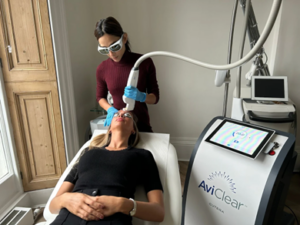
Most traditional lasers do not treat the biology of acne. They improve redness and support scarring work once inflammation has settled, but they do not influence oil production or breakouts themselves. AviClear is different. Its 1726 nm wavelength is designed to target the sebaceous glands directly, and this allows it to reduce oil output over time and treat active acne in a medically meaningful way. It is suitable for people who cannot or do not wish to take systemic medication, for those with recurring acne after medication, and for all skin types because the wavelength bypasses epidermal melanin. Improvement develops gradually as the glands regulate themselves, and many people notice reduced oiliness before breakouts diminish.
Is laser suitable for my age?
Laser suitability is not determined by age but by skin health, expectations and goals. Younger individuals may seek treatment for acne scarring or pigmentation. Older individuals may address photoageing, texture and redness. The question is not whether you are the right age, but whether the diagnosis is correct, the device is appropriate, and the outcome aligns with your goals.
Age becomes relevant only when considering healing capacity and medical history. A thoughtful clinic will consider these factors and adjust treatment accordingly.
How clean and safe should the treatment environment be?
The treatment environment should feel like a medical space. The room should be clean, uncluttered and appropriately ventilated. Surfaces should be wipeable. Eye protection should be available and wavelength-specific. The practitioner should use gloves, and consumables should be sterile. Plume extraction should be present during resurfacing. Equipment should be regularly maintained and calibrated.
These details may not be immediately obvious to patients, which is why they should be unmissable to the practitioner. A clinic that treats lasers with the seriousness it deserves will display that seriousness in its environment.
What happens during a high-quality laser consultation?
A high-quality consultation begins with listening. A practitioner should take time to understand your concerns, examine your skin under proper lighting and ask about your medical history, lifestyle, sun exposure, skincare routine and previous treatments. They should diagnose the problem accurately and explain the biological processes behind it. They should outline your options clearly, including non-laser options where appropriate.
They should then explain the device they recommend, why it is suitable, what it targets, how many sessions are typical, what downtime you can expect, how to prepare and how to care for your skin afterwards. They should give you written information and answer your questions patiently. A clinic that rushes this stage is not operating at a medical standard. Laser is powerful. Proper consultation is part of its safety.
How should I judge before-and-after photos?
Before-and-after photos can be misleading if taken in different lighting, angles or conditions. A responsible clinic uses standardised photography that allows fair comparison. The lighting should be identical. The background should be neutral. The facial position should be consistent. The time interval should be realistic.
Ask whether the photos presented reflect typical results or the best outcomes. Ask whether the lighting and settings are consistent. Ask whether the clinic can show you examples of cases similar to yours. Photographs are helpful only when they are honest.
What makes Self London’s laser practice different?
This guide is not about promoting Self London, but context matters. Patients often ask what distinguishes a dermatology-led clinic from the wider aesthetic landscape. Self London was built to bring together medical dermatology, advanced laser practice and a culture of calm, deliberate care. All diagnoses are made by a consultant dermatologist-led team. Treatment plans are medically led. VISIA imaging is used to provide an objective assessment. The clinic operates within CQC regulations and works with laser protection advisors. Complications are audited. Aftercare is structured.
Devices are chosen intentionally, not for marketing. Protocols are refined continuously, informed by experience across diverse skin types. Some treatments are carried out by the consultant dermatologist; others are performed by senior laser practitioners trained to medical standards. Every treatment is guided by the central principle that the diagnosis dictates the device, not the other way around.
This does not make Self London the only good clinic in the UK. But it does illustrate the standards that patients should expect. Clinics that treat lasers as a serious medical tool will always deliver safer, more thoughtful care than those who treat it as a commodity.
How should I make my final decision?
Your decision should be shaped by trust, clarity and clinical reasoning. Choose the clinic that explains your diagnosis with precision. Choose the clinic that does not rush you. Choose the clinic that documents your skin properly, speaks honestly about risk, adjusts for your skin type and has the governance to support you if something unexpected happens.
Laser is a partnership between practitioner and patient. When you choose well, the partnership is built on understanding and expertise. When you choose poorly, the relationship is based on convenience and hope. Skin deserves better than hope. It deserves accuracy.
The purpose of this guide
This guide exists because patients deserve information that goes beyond the superficial. Good outcomes in dermatology are built on diagnosis, biology, safety and expertise. Devices matter, but judgment matters more. High-quality laser practice is not defined by branding or aesthetics but by thought, structure and integrity.
When you know what to ask, you will not be misled by marketing. You will immediately recognise which clinics operate with depth and which rely on surface. You will see the difference between a practice that understands your skin and one that simply possesses a machine. Laser can change skin. Understanding can change decisions. Together, they change outcomes.