
Many patients notice that their neck appears to age faster than their face. Jawline definition softens, the transition between face and neck becomes less distinct, and laxity develops beneath the chin or along the upper neck, often while facial skin quality remains good. This pattern of early neck ageing is increasingly common in UK patients in their thirties and forties, particularly those with desk-based or home-based work, even when sun exposure is low.
In most cases, this is not because the neck is ageing more rapidly in biological terms. It is because the neck is exposed to sustained mechanical load from posture, muscle tone and daily working habits in a way the face is not. This pattern is often attributed to thin skin, poor genetics or “tech neck”. None of these explanations is sufficient. To understand why the neck behaves as it does, it has to be viewed not as a passive surface, but as a structurally active region ageing under load.
The neck occupies a unique anatomical position. It supports the head, connects the torso to the face, and acts as a conduit for posture, movement and force transmission. It is active even at rest, continuously engaged in maintaining balance and orientation. Despite this, neck ageing is usually discussed as a skin problem, framed in terms of laxity, fine lines or collagen loss. Treatments then focus on surface quality or isolated tightening, with variable and often short-lived results.
This approach fails because it ignores the conditions under which neck tissue is being asked to function. Ageing does not occur in isolation from exposure. Tissues age under the forces they are repeatedly subjected to. Time matters, but so does load.
Traditional dermatology models ageing as a time-dependent biological process. Collagen synthesis declines, elastin fragments, cellular turnover slows and cumulative ultraviolet exposure accelerates these changes. This framework explains many features of skin ageing and remains essential. What it does not explain well is variation. Two individuals of similar age, skin type and sun exposure can show markedly different patterns of neck ageing. The neck often appears to age faster than the face, and changes may become apparent after long days at a desk or worsen as the day progresses. These observations point to a second axis of ageing alongside time: cumulative mechanical exposure.
Skin-only explanations struggle because skin does not exist independently of structure. It sits within a system shaped by muscle tone, connective tissue tension and posture. It responds not only to biochemical signals, but also to physical forces. When that mechanical environment is unfavourable, surface treatments alone rarely produce durable change.
Volume-first approaches fail for similar reasons. Jawline and neck changes are often interpreted as sagging caused by volume loss, leading to attempts to restore support with filler. In a subset of patients this can be appropriate. In many others, it worsens heaviness without restoring definition. These patients are not volume deficient. They are experiencing downward vector forces acting on tissue that has lost resilience. Adding volume without addressing those forces compounds the problem rather than solving it.
Why tech neck is an incomplete explanation
The popular term “tech neck” illustrates the same misunderstanding in simplified form. It implies that neck ageing is caused by looking down at devices and that the solution lies in avoiding phones or smoothing lines. The problem is not device use itself. It is a prolonged static load in a region that is structurally vulnerable. The neck is not simply folding. It is ageing under sustained mechanical stress.
The adult human head weighs approximately five kilograms. When it is balanced directly over the shoulders, this weight is transmitted efficiently through the cervical spine and supporting structures. Muscle activity remains economical, with deep stabilisers maintaining alignment and making small adjustments as needed. As the head moves forward, even by a small amount, this balance changes. Muscles must generate greater force to prevent further forward displacement. This increase in load does not require extreme posture. It occurs within ranges that feel habitual rather than strained.
Desk-based work reliably encourages this configuration. Screens positioned below eye level, laptops used without stands, and chairs that allow thoracic collapse all promote forward head posture and shoulder rounding. For many people working from home, this exposure is amplified by makeshift workstations, dining chairs without upper-back support, low laptop screens and long periods of uninterrupted sitting, all of which increase sustained cervical load without the individual realising it. In these conditions, the neck is rarely moving dynamically. It is held. The distinction between movement and holding is critical. Movement distributes load and allows recovery. Holding concentrates load and sustains it.
When muscles are required to maintain position rather than produce movement, baseline tone increases. Over time, the neuromuscular system adapts, recalibrating what it considers normal. In the neck, this pattern typically involves the upper trapezius, cervical extensors and superficial muscles that interface with fascia and skin. One of the most relevant of these is the platysma.
The platysma is a thin, superficial muscle extending from the fascia of the upper chest and shoulder region to the mandible and lower face. Functionally, it contributes to depression of the lower face and tensioning of the neck skin. When baseline activity in this muscle increases, downward forces on the jawline and upper neck become more persistent. This does not occur abruptly. It develops gradually alongside habitual posture, often without the individual being aware of it.
These changes are frequently interpreted as gravity acting on ageing tissue. Gravity has always been present. What has changed is the direction and persistence of muscular forces acting on the region. Fascial continuity amplifies this effect. The face and neck are organised into layered connective tissue planes rather than isolated compartments. Force generated in the neck and upper chest is transmitted upward, influencing how the lower face is supported and how skin drapes across underlying structures.
This is why changes in posture can alter appearance in real time. Many people notice sharper jawline definition when standing tall or moving, and increased blurring when fatigued or slumped. These observations reflect genuine changes in force distribution rather than subjective perception.
Skin responds to this environment. Dermal fibroblasts alter collagen production and organisation in response to stretch, compression and tension. This process, known as mechanotransduction, is well established in skin biology. Over time, repeated deformation and sustained tension lead to mechanical fatigue. Collagen fibres become less organised, elastic recoil diminishes and creases persist.
Why does the neck show fatigue so early?
The structural properties of neck skin compound this effect. Compared with facial skin, neck skin has a thinner dermis and greater extensibility, with less dense underlying support. These characteristics make it less tolerant of sustained deformation. When exposed to similar forces, it reaches fatigue sooner. This helps explain why many patients feel their neck looks older than their face, and why neck changes can be particularly resistant to surface treatments.
Importantly, this process does not require visibly poor posture. Many patients presenting with early neck ageing would not be described as having bad posture in any dramatic sense. The issue lies in duration rather than extremity. Tissue response is driven by cumulative exposure. Long hours of static desk work, repeated day after day, are sufficient.
Why diagnosis determines treatment outcomes
Most dissatisfaction with non-surgical neck treatments arises not because technology fails, but because diagnosis is incorrect. When neck ageing is driven primarily by sustained downward vector forces and mechanical fatigue, volume-based correction frequently worsens heaviness rather than restoring definition. In these cases, prioritising skin quality or adding filler without addressing load and tissue resilience produces short-lived or disappointing results. A structural diagnosis is therefore not optional. It is the difference between improvement and regret.
Prevention and treatment must therefore focus on altering the conditions under which the neck continues to age. Workspace design is a practical starting point. Screen height at eye level, external keyboards and mice that allow laptops to be raised, and chairs that support thoracic extension reduce sustained cervical load. Regular changes in position redistribute forces and allow recovery. The goal is not perfect posture, but reduced cumulative stress.
Strength and conditioning play a complementary role. Early neck ageing is often associated with an under-recruited posterior chain and limited thoracic extension. When upper-back musculature and scapular stabilisers are weak or poorly coordinated, superficial neck muscles compensate. Strengthening the posterior chain and restoring thoracic mobility allows the head to sit more easily over the shoulders, reducing reliance on constant cervical bracing. These changes alter force distribution without requiring conscious effort to “hold” posture.
When structural changes are already established, in-clinic treatments can support tissue resilience and improve how the neck responds to ongoing load. In load-dominant neck ageing, treatments that improve dermal resilience without adding volume are often the most appropriate first step.
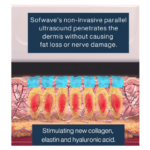
Ultrasound-based collagen stimulation, such as Sofwave, targets the mid-dermis where tensile strength is generated. By improving collagen density at this level, the neck becomes more resistant to deformation from ongoing mechanical stress. This makes Sofwave particularly suitable for early laxity, loss of firmness and jawline blurring driven by posture rather than volume loss. Its value lies in durability rather than immediacy.
Laser coring is most useful where neck ageing is focal rather than diffuse, particularly along the jawline and upper neck where downward forces concentrate. Unlike surface resurfacing, coring allows targeted stimulation of deeper dermal support in structurally weak zones, improving definition without increasing bulk. This makes it appropriate where heaviness is already a concern and precision matters.
Fractional laser treatments such as UltraClear play a complementary role by improving dermal density and skin quality. In necks showing early creasing and reduced elasticity, improved tissue quality enhances the skin’s ability to tolerate mechanical stress over time. While this does not replace structural intervention, it meaningfully improves long-term outcomes when used within a diagnostic framework.
A structural framework for neck ageing
The key to effective treatment is sequencing. Not every neck requires the same intervention. Some are dominated by mechanical fatigue and downward vector forces. Others show genuine volume loss or significant photodamage. Treating all necks as though they share the same problem leads to predictable dissatisfaction. Diagnosis must precede treatment, and treatments must be chosen to address the cause rather than the appearance alone.
This mechanical framework is how neck ageing is assessed in practice at Self London. Rather than treating the neck as an isolated aesthetic concern, posture, muscle tone, daily mechanical exposure and tissue resilience are considered alongside skin quality and anatomy. Treatments such as Sofwave, laser coring and UltraClear are selected and sequenced according to diagnosis, to produce durable improvement rather than short-lived change.
Neck ageing is not simply a failure of skincare, nor is it an inevitable consequence of time. It reflects the forces placed on tissue repeatedly and over the years. Understanding those forces allows for better decisions and more durable outcomes. The aim is not to halt ageing, but to change its trajectory by modifying the conditions under which it occurs. Neck ageing is not a cosmetic failure to be corrected, but a structural process to be understood; when it is approached with that clarity, outcomes become more predictable, more durable, and far less disappointing.