Almost everyone who has lived with acne carries some memory of it. For many, the memory is emotional rather than visible; once inflammation subsides, the skin eventually clears and evens. For others, acne leaves a permanent imprint; a topography of tiny hollows, ridges or shadows that remain long after the breakouts have stopped. These are not residual blemishes but lasting structural injuries.
Why some people scar while others do not is one of the most complex questions in dermatology. It involves genetics, the chemistry of inflammation, the timing of treatment, and the precision of healing. To understand why some acne scars never fade, it helps to start with how the skin is built and what happens when its architecture is disrupted.
How healthy skin repairs itself
The skin is an organ of structure. Beneath the thin epidermis lies the dermis, a latticework of collagen and elastin fibres woven through ground substance that gives the skin its strength, elasticity and ability to heal. When injured, this tissue repairs itself through three overlapping phases— inflammation, proliferation and remodelling.
During inflammation, immune cells rush to the site to clear bacteria and debris. In the proliferation phase, cells known as fibroblasts migrate into the wound and begin to secrete new collagen and extracellular matrix to fill the gap. Over time, during remodelling, this newly formed collagen, initially type III, which is flexible, is replaced with the stronger, more structured type I collagen.
When this choreography proceeds smoothly, the repaired area blends almost seamlessly with the surrounding tissue. The wound closes and the surface looks normal. Acne interrupts this sequence in ways that make such seamless healing impossible.
What does acne do to the dermis?
A typical acne lesion forms when oil, keratin and bacteria become trapped inside a hair follicle. As pressure builds, the follicle wall ruptures and its contents spill into the surrounding tissue. The immune system responds aggressively. White blood cells release enzymes and inflammatory mediators known as cytokines such as interleukin-1, interleukin-6 and tumour necrosis factor-alpha to neutralise bacteria and digest damaged tissue.
The collateral damage is extensive. These same enzymes degrade the collagen and elastin network in the dermis. In mild, superficial acne, the destruction is limited; the surrounding collagen framework remains intact and the skin can repair itself. In nodular or cystic acne, inflammation extends deep into the reticular dermis, damaging collagen. When the inflammation finally resolves, fibroblasts are left trying to rebuild a collapsed scaffolding.
The result is scar tissue that differs fundamentally from healthy dermis. Its collagen fibres are shorter, thicker and oriented randomly rather than in organised bundles. The tissue is less vascular, less elastic and less reflective of light. Once this architecture forms, the skin cannot spontaneously revert to its pre-acne structure.
Who is most at risk of scarring
Not all acne produces scars, and not all individuals scar to the same degree. Several biological and behavioural factors shape this risk.
People with deep cystic or nodular acne are most vulnerable because inflammation extends through multiple layers of the dermis and into the subcutaneous tissue. The longer such lesions persist, the more dermal collagen is destroyed.
Genetic differences also influence how efficiently fibroblasts replace lost tissue. Some individuals overproduce inflammatory cytokines or certain matrix metalloproteinases (MMPs) that degrade collagen. Others produce less transforming growth factor-beta (TGF-β), a molecule critical for balanced repair. The result can be either insufficient collagen deposition, leading to atrophic scars, or excessive collagen deposition, leading to hypertrophic or keloid scars.
Skin type affects not only the appearance but also the behaviour of scars. In lighter skin tones, the loss of collagen appears as indentation and shadow; in darker skin tones, the inflammatory response may trigger increased melanin activity, creating a raised or pigmented scar.
Hormonal fluctuations can amplify risk by prolonging inflammation and oil production. And mechanical trauma such as squeezing, scratching, or repeated friction, can rupture follicles that might otherwise have healed quietly.
Finally, timing matters. The longer inflammatory acne remains untreated, the greater the cumulative damage to the dermal matrix. Early medical management significantly reduces risk, yet many people delay treatment, either hoping acne will resolve on its own or cycling through over-the-counter products that do little to curb deep inflammation.
Why some marks fade and others do not
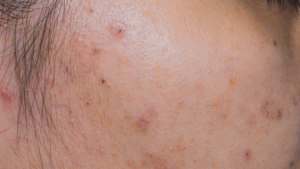
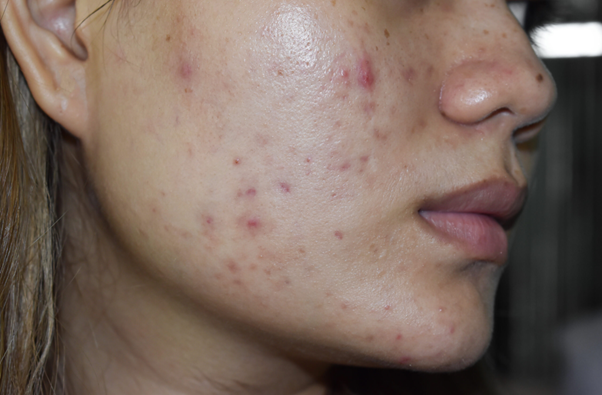
After a flare, the skin often shows temporary discolouration. These red or brown areas (post-inflammatory erythema and hyperpigmentation respectively) are not scars. They represent lingering blood vessels or melanin within the epidermis and upper dermis and generally fade with time, skincare and ultraviolet protection.
A true scar forms when the injury extends deep enough to destroy the dermal collagen framework. The body replaces this with fibrotic tissue that lacks the elasticity and uniformity of healthy skin. Because this tissue does not undergo normal cellular turnover, it remains visible indefinitely.
This is why creams, serums and peels cannot erase genuine atrophic scars. Their activity is confined to the surface layers. They may refine texture and stimulate mild collagen in the papillary dermis, but they cannot reach the depth where structural repair is needed.
The microscopic biology of scarring
Within the deeper layer of the skin, the dermis, fibroblasts are responsible for synthesising new collagen and elastin. When inflammation is excessive, these cells are exposed to high levels of reactive oxygen species and inflammatory mediators that impair their function. Matrix metalloproteinases become over-active, breaking down existing collagen faster than it can be replaced.
Even once inflammation subsides, the local environment remains altered. Scar tissue contains fewer fibroblasts, reduced blood supply and abnormal ratios of collagen types I and III. The fibres are arranged haphazardly and tethered by cross-links that make the tissue rigid. This structural rigidity is what creates visible depressions or raised plaques.
Over years, as natural collagen production slows with age, these irregularities can appear more pronounced. What seemed minor in adolescence becomes more visible in one’s thirties or forties, not because the scar has worsened but because the surrounding tissue has thinned. This is why acne scarring often looks more prominent with age.
The principle of controlled renewal
Reversing a scar requires stimulating the skin to remodel itself from within. The challenge is to create enough injury to activate fibroblasts without damaging surrounding tissue. Modern dermatology achieves this through controlled energy delivery, heat, light or mechanical disruption applied at specific depths and densities.
When the dermis is exposed to precise thermal or mechanical stress, fibroblasts begin producing new collagen and reorganising existing fibres. Over months, the scar tissue becomes more flexible and reflective. The surface appears smoother not because the scar has been “filled in,” but because the microscopic architecture has been rebuilt.
This process is slow but measurable. Collagen synthesis peaks about twelve weeks after stimulation and continues to remodel for up to a year.
Why accurate diagnosis matters
Not all scars behave alike. Ice-pick scars are narrow and deep, requiring treatment that reaches their base such as laser coring. Boxcar scars have defined edges and respond best to fractional or full ablation. Rolling scars are tethered to deeper tissue by fibrous bands that must be released mechanically before the surface can rise. Hypertrophic and keloid scars need a completely different approach, modulating collagen production rather than stimulating it.
Without careful diagnosis, the wrong treatment can exacerbate scarring or pigmentation. True evaluation involves assessing the type, depth and distribution of scars under controlled lighting and, when appropriate, imaging to quantify texture and pore topography.
At Self London, diagnostic imaging such as VISIA is used not as a marketing add-on but as a scientific tool. It provides baseline data that allows objective tracking of improvement and helps to select the most appropriate combination of modalities. The consultation also confirms that acne itself is inactive; treating scars while inflammation persists risks recurrence and further injury.
Evidence-based modalities for structural repair
Modern laser and energy-based technologies offer ways to remodel scar tissue with precision. Fractional Erbium:YAG and UltraClear 2910 lasers ablate microscopic columns of skin, each surrounded by healthy tissue that speeds healing. The energy is absorbed by water in the skin, producing controlled micro-wounds that trigger new collagen and elastin formation. The result is smoother, more uniform skin with significantly reduced downtime and less risk of prolonged redness or pigmentation compared with older carbon-dioxide lasers.
Where scars are tethered, subcision or laser coring can release fibrous bands beneath the surface. Once freed, the area can be resurfaced to encourage even regrowth. For widespread fine textural change or mixed scar patterns, hybrid fractional systems such as Halo deliver two wavelengths simultaneously (one ablative, one non-ablative) to target multiple depths in a single pass.
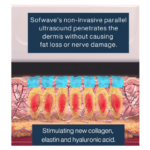
For patients seeking subtle improvement with no visible recovery period, non-ablative ultrasound treatments such as Sofwave heat the mid-dermis to stimulate collagen contraction and synthesis without disrupting the surface.
Regenerative injectables like polynucleotides complement these procedures biologically. They enhance fibroblast proliferation, improve local circulation and support tissue regeneration between laser sessions.
These techniques do not compete but interlock. The appropriate combination depends on scar morphology, skin tone and healing capacity. Successful outcomes arise from sequencing, not from the power of a single device.
The role of the consultation
A consultation for acne scarring is a medical and diagnostic assessment. It establishes whether the skin is ready for treatment, which scars should be prioritised, and how much recovery time a patient can realistically manage.
During consultation, the clinician reviews medical history, previous treatments, and current skincare to identify potential barriers to healing such as photosensitising medications or recent retinoid use. The patient’s goals are discussed openly to align expectations with biological reality.
This planning stage determines not only safety but also efficiency. By understanding the biology of the individual’s scars, the clinician can select parameters that achieve maximal improvement with minimal risk. You can contact our medical dermatology clinic in Harley Street to book a consultation.
The course of healing
After any energy-based or mechanical treatment, fibroblasts become active and remain so for months. Collagen is deposited in a framework that gradually contracts and strengthens. Improvements accumulate rather than appear instantly.
Patients often notice early changes in skin texture within six to eight weeks, followed by continued refinement over the next several months. Because collagen maturation is slow, results continue to evolve long after visible redness has faded.
Realistic expectations are crucial. Complete erasure of scars is not possible; a 50 to 70 per cent improvement in depth, texture and light reflection is considered an excellent outcome. The objective is to create skin that behaves and looks more like unscarred tissue, not to rewrite the past entirely.
Why early, informed care prevents future scars
The most effective treatment for acne scarring remains prevention. Managing active acne early with medical or energy-based therapies limits inflammatory destruction before it begins. Delaying professional intervention allows deeper lesions to form and multiplies the likelihood of long-term damage.
Recognising that acne is a medical condition, not a cosmetic inconvenience, changes the trajectory of care. Seeking help promptly, rather than after years of experimentation, protects both skin health and self-confidence.
Living with and treating scars
Acne scarring carries emotional as well as physical weight. It often appears during adolescence or young adulthood, when identity and self-esteem are particularly fragile. The visibility of scars can reinforce the memory of an illness long after it has resolved.
Dermatology today cannot return skin completely to its untouched state, but it can restore coherence. Through structured, evidence-based protocols, it is possible to soften shadows, smooth transitions and re-establish the skin’s natural light reflection. Each improvement in texture is mirrored by an improvement in the way people experience their own reflection.
At Self London, scar revision is approached as restoration rather than correction: rebuilding integrity, supporting the biology of healing and guiding the skin back toward balance. The objective is not a perfect surface but a functional, confident one.
The science of regeneration
Collagen remodelling is ultimately an act of regeneration. It reminds us that even damaged tissue retains the potential to repair, given the right stimulus and time. The body’s own fibroblasts are the real healers; technology simply provides the signal.
Understanding the science behind that process, how inflammation disrupts, how fibroblasts rebuild, how energy can recalibrate the balance, allows patients to make decisions based on biology. It transforms treatment from a search for quick fixes into a partnership between doctor and patient, grounded in evidence and respect for the skin’s complexity.
Scars that do not fade are reminders of inflammation past, but they need not be permanent markers of it. With accurate diagnosis, gentle precision and patience, the skin can relearn its architecture.