Skin tightening is one of the most sought-after goals in modern aesthetics, yet it is also one of the most misunderstood. True rejuvenation is not about chasing fads or aggressive interventions; it is about restoring structural integrity, encouraging healthy collagen renewal and preserving natural facial proportions over time.
Two of the most frequently discussed options are ultrasound-based tightening (represented by Sofwave) and radiofrequency microneedling (represented by devices such as Morpheus8). Both aim to stimulate new collagen and elastin, but the way they do so, and the type of patient each suits, are very different.
At Self London, we invest in a range of energy-based systems, including advanced resurfacing lasers such as UltraClear 2910, Halo Hybrid, full and fractional erbium:YAG. These technologies already address texture and scarring effectively. Our tightening platform, therefore, had to meet a different standard: predictable lifting, minimal downtime and a strong safety profile across diverse skin tones. For that reason, we chose Sofwave.
Understanding the Science
Sofwave: Targeted Ultrasound Energy

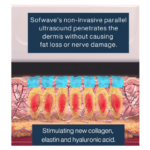
Sofwave uses Synchronous Ultrasound Parallel Beam (SUPERB) technology to deliver controlled thermal energy to the mid-dermis at a depth of approximately 1.5 millimetres. The treatment creates uniform zones of collagen denaturation while leaving the epidermis intact. Integrated cooling protects the surface, and because there is no needle entry or ablation, the skin barrier remains unbroken.
The biological outcome is collagen and elastin synthesis through wound-healing pathways without visible trauma. The technology has been cleared by the U.S. Food and Drug Administration (FDA) for lifting the eyebrow, submental (tissue under chin) and neck areas, reduction of fine lines and wrinkles, and improvement in the appearance of cellulite, acne scars and skin laxity on the upper arms. The mechanism is predictable, uniform and does not rely on the variability of needle insertion.
RF Microneedling: Heat Through Invasive Delivery

Radiofrequency microneedling delivers energy through arrays of needles that penetrate the skin at variable depths, releasing heat into the dermis and sometimes the subdermis. The combination of mechanical injury and thermal stimulation triggers collagen remodelling and, in some cases, adipose contraction. While this can be effective for textural change or acne scarring, it also means the surface barrier is intentionally disrupted.
In darker skin types or in patients prone to pigmentation, that disruption increases the risk of post-inflammatory hyperpigmentation, scarring or uneven texture. The degree of trauma also dictates the amount of downtime.
Clinical Indications and Patient Selection
Every tightening treatment should start with diagnostic clarity. Is the primary issue early laxity, mild jowling or a loss of elasticity around the eyes and neck? Or is it acne scarring, pore enlargement or coarse texture? These are not interchangeable indications.
At our cosmetic dermatology clinic in Harley Street, we reserve barrier-disruptive treatments, such as fractional lasers, for patients requiring resurfacing or scar correction. When the goal is to lift, tighten and maintain collagen without visible downtime, an ultrasound-based approach is usually more appropriate.
Recovery and Lifestyle Compatibility
One of the most practical differences between the two technologies is what happens immediately after treatment.
Sofwave typically requires around forty-five minutes. Most patients leave with mild warmth or slight redness that resolves within hours. There are no marks, micro-channels or oozing. Makeup, exercise and work can resume almost immediately. Because the epidermis is preserved, infection risk is extremely low.
RF Microneedling, by contrast, involves several days of visible recovery. Pinpoint bleeding, swelling, crusting and transient track marks are common. Aftercare is essential and includes avoidance of heat, makeup and exercise for several days. In the wrong hands or at excessive depths, there is potential for uneven thermal spread, fat loss or nerve irritation.
For many of our patients – professionals, performers, parents, or those frequently in front of cameras – extended downtime is not an option.
Safety, Regulation and the 2025 FDA Communication
In October 2025, the FDA issued a Safety Communication titled “Potential Risks with Certain Uses of Radiofrequency (RF) Microneedling Devices.” The document highlighted serious adverse events, including burns, scarring, fat atrophy, nerve injury and disfigurement, and reminded practitioners that RF microneedling is a medical procedure that must only be carried out by trained healthcare professionals.
The alert did not single out any one brand but emphasised that device calibration, operator training and governance determine safety. Inexperienced use, aggressive parameters or delegation outside a medical framework increase risk.
Ultrasound devices such as Sofwave, which do not puncture the skin and incorporate real-time temperature monitoring with active cooling, were not subject to this class warning. The difference is not trivial: it reflects a fundamentally lower level of invasiveness and a wider therapeutic window for safe energy delivery. Every device carries potential for misuse, but when a technology’s mechanism inherently avoids barrier trauma, its margin for safety is inherently greater.
Efficacy and Clinical Evidence
Both ultrasound and RF microneedling stimulate collagen through controlled heat. The key is the distribution of that heat.
Sofwave creates uniform thermal zones within the mid-dermis, stimulating neocollagenesis without coagulative injury at the surface or in the fat layer. The process tightens fibrous septae and re-densifies dermal collagen over several months. Peer-reviewed studies demonstrate measurable lifting of the eyebrow and submental region with minimal adverse effects.
RF microneedling produces multiple discrete columns of coagulative injury that extend from the surface downward. This can improve scars and coarse texture but also introduces healing variability, especially when energy delivery is inconsistent across needle arrays. The deeper passes used for tightening often come with increased pain and risk.
At Self London, we already possess more precise instruments for controlled dermal remodelling (fractional and full ablation erbium:YAG, Halo Hybrid and UltraClear 2910 lasers) which offer calibrated resurfacing with reproducible histological outcomes. In this context, an additional RF microneedling system would duplicate, not enhance, our existing capability. For tightening and lifting, Sofwave complements our technology portfolio rather than overlapping with it.
Why Operator Skill and Protocol Design Matter
Technology is only one component of a successful outcome. The clinician, the protocol and the diagnostic framework are equally critical.
- Diagnosis: Understanding whether laxity arises from collagen depletion, skeletal change, fat descent or previous treatments informs which device is appropriate.
- Parameters: Energy intensity, pulse overlap and coverage density must be tailored to each patient’s skin type, thickness and tolerance.
- Sequencing: Devices should be integrated into a wider plan that may include nutritional optimisation, skincare and other regenerative treatments.
- Governance: Aesthetic procedures are safest in CQC-registered doctor-led clinics with rigorous consent, imaging and complication-management systems.
At Self London, every Sofwave treatment sits within such a structure. Treatments are not delegated to unsupervised technicians, and settings are adjusted according to clinical photography, VISIA imaging and patient response. This ensures that the energy delivered achieves physiological change without excessive discomfort or risk.
Suitability and Skin Diversity
Sofwave is suitable for all Fitzpatrick skin types and is particularly valuable for those prone to pigmentary change, because it leaves the epidermis untouched. It is ideal for early to moderate laxity, jawline softening and brow descent, and can be repeated periodically to maintain collagen density.
RF microneedling can play a role in thicker or scarred skin where controlled injury is desired, but it requires careful patient selection and strict adherence to aftercare. In darker complexions, laser or microneedling treatments that disrupt the barrier must be approached conservatively to avoid hyperpigmentation.
For the majority of tightening indications, a non-invasive ultrasound approach provides a safer and more consistent path to improvement.
Integrating Technology Intelligently
A clinic that already offers fractional and hybrid lasers for resurfacing does not require another device that damages the surface to achieve tightening. The advantage lies in complementarity, not duplication.
Sofwave occupies a distinct position within our protocol architecture: it delivers vertical lift and collagen remodelling at the mid-dermal level, while our fractional lasers handle surface refinement and scar remodelling. Together they address both the structure and the texture of the skin without unnecessary overlap or downtime.
This layered methodology mirrors how we practise dermatology more broadly: evidence first, protocol next, device last.
The Broader Context of Intelligent Aesthetics
Skin tightening is part of a continuum of care that includes muscle support, metabolic health and structural maintenance. At Self London, devices such as Sofwave and Pure Impact form part of a wider longevity framework that aims to preserve integrity from the dermis to the deeper fascia and musculature.
Patients on GLP-1 medications or experiencing rapid body composition changes often notice laxity as a secondary effect of fat reduction. In such cases, Sofwave provides a valuable non-surgical intervention to stimulate dermal support without compromising volume.
This kind of strategic integration defines intelligent aesthetics. It is less about “what’s new” and more about “what makes sense”.
Summary: Choosing the Right Path
When comparing Sofwave and RF microneedling, it is helpful to return to first principles. Both can stimulate collagen. Both can improve skin quality. The difference lies in how predictably they do so, how safely, and with what cost to daily life.
| Parameter | Sofwave (Ultrasound) | RF Microneedling |
| Mechanism | Focused ultrasound heat in the mid-dermis | Needles deliver radiofrequency heat through the skin |
| Skin disruption | None (epidermis intact) | Yes (micro-channels created) |
| Downtime | Minimal | Several days |
| Risk of pigment change | Very low | Higher, especially in darker skin types |
| Comfort | Requires a topical anaesthetic | Requires a topical anaesthetic |
| Suitability | All skin types, mild-moderate laxity | Textural change, scarring, thicker skin, laxity |
| Regulatory alerts | None | FDA class warning (2025) |
| Integration at Self London | Primary tightening platform | Not required due to the advanced laser suite |
The Self London Perspective
Our role is not to sell a device but to curate a pathway that aligns with your goals, biology and schedule. In practice, this means using ultrasound-based tightening for structural lift and skin integrity, reserving resurfacing and microneedling-type interventions for scars and texture when clinically indicated.
In capable, doctor-led protocols, Sofwave delivers measurable lift, improved tone and smoother contours with almost no interruption to daily life. It is not the loudest treatment on social media, but it is one of the most refined in evidence and outcome.
When combined with strong skincare, nutrition and other regenerative modalities, ultrasound tightening forms the foundation of long-term dermal health. It is a modern answer to the question patients ask most often: how can I look better without looking treated?
In summary:
RF microneedling can be useful in expert hands for specific textural indications, but for most patients seeking genuine tightening, in our experience, Sofwave offers the safer, more intelligent and lifestyle-compatible route. It represents what we value most at Self London: precision, predictability and the quiet confidence of results that do not announce themselves, but simply restore what time has softened. Book a Sofwave consultation at our clinic in Harley Street to get started.